A Daniell Cell is an electrochemical cell that converts chemical energy into electrical energy through a spontaneous redox reaction. It is also referred as a galvanic or voltaic cell. It consists of two half-cells that are connected by a salt bridge to maintain electrical neutrality through the flow of ions. The first half-cell consists of a Zn rod dipped in a ZnSO4 solution, while the other half-cell consists of a Cu rod immersed in a CuSO4 solution. The two rods are connected by a wire to complete the circuit through which the electron flows, and a voltmeter may be connected in the circuit to measure the electrode potential. If the circuit in a Daniell cell represented by the cell notation, Zn | Zn2+ || Cu2+ | Cu, is closed, then it is observed that as time passes the concentration of Zn2+ keeps on increasing, while the concentration of Cu2+ keeps on decreasing. At the same time, the voltage of the cell as read on the voltmeter keeps on decreasing. After some time, the voltmeter shows zero reading.
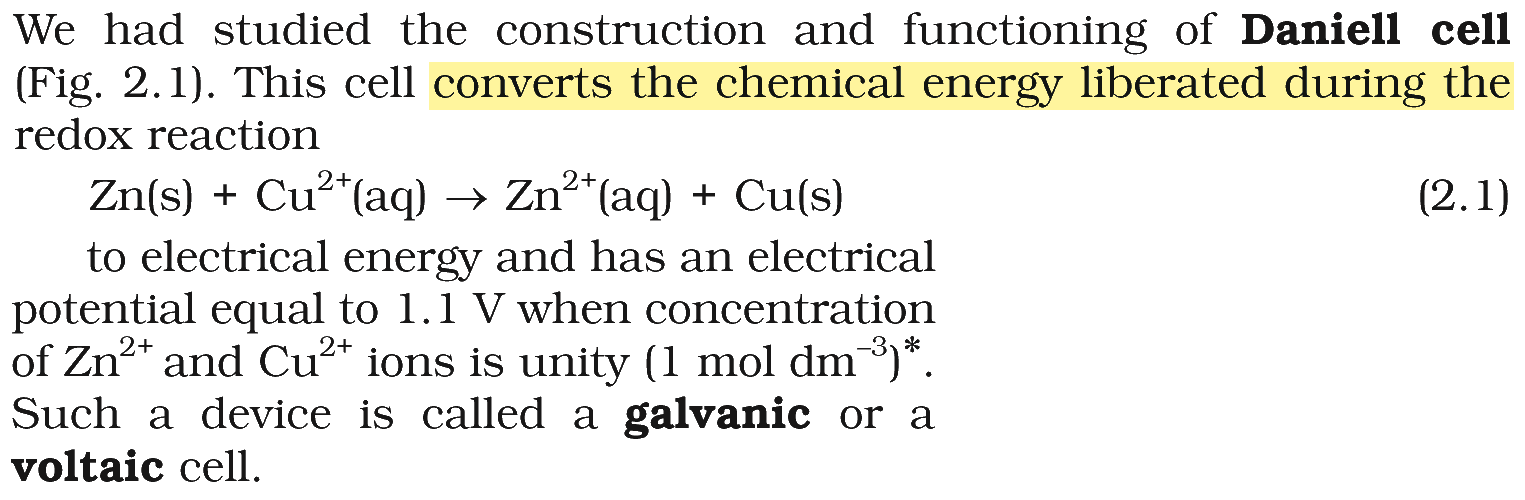
The cell reaction for the above Daniell cell is
Answer & explanation
Correct answer: option 1
The correct answer is Option (1) → Zn(s) + Cu2+(aq) → Zn2+(aq) + Cu(s)
In the cell notation, the anode (oxidation) is written on the left and the cathode (reduction) on the right: Zn | \( \ce{Zn^{2+}} \) || \( \ce{Cu^{2+}} \) | Cu. The cell reaction is the sum of the two half reactions:
\( \displaystyle \text{Anode: }\ce{Zn(s) -> Zn^2+(aq) + 2e^-} \)
\( \displaystyle \text{Cathode: }\ce{Cu^2+(aq) + 2e^- -> Cu(s)} \)
\( \displaystyle \text{Cell: }\ce{Zn(s) + Cu^2+(aq) -> Zn^2+(aq) + Cu(s)} \)
This agrees with the passage: \( \ce{[Zn^{2+}]} \) increases and \( \ce{[Cu^{2+}]} \) decreases as the cell works. Metals are solids and their ions are in aqueous solution.
Why the other options are incorrect
Option (2) Zn(aq) + Cu2+(s) → Zn2+(s) + Cu(aq) — Incorrect. The species are right but the physical states are swapped; the metals are solids (s) and the ions are aqueous (aq).
Option (3) Cu(s) + Zn2+(aq) → Cu2+(aq) + Zn(s) — Incorrect. This is the reverse reaction. Its E° is −1.10 V, so it is not spontaneous and cannot drive a galvanic cell.
Option (4) Cu(aq) + Zn2+(s) → Cu2+(s) + Zn(aq) — Incorrect. This is the reverse reaction, and the states are also wrong.
NCERT (2026-27 edition):
Electrochemical Cells – …