Molar conductivity(Λm) of a solution increases when
(A) Area of cross section of electrode increases.
(B) Distance between the electrode decreases.
(C) Concentration of the solution decreases.
(D) Concentration of the solution increases.
Choose the correct answer from the options given below:
Answer & explanation
Correct answer: option 4
The correct answer is Option (4) → (C) only
The conductivity (κ) of a solution is the conductance of 1 cm3 of it, placed between electrodes of 1 cm2 area kept 1 cm apart. The conductance of any other cell depends on its geometry, but κ itself does not:
\( \displaystyle G=\kappa\,\frac{A}{l} \)
The molar conductivity (Λm) is the conductivity of the volume of solution that contains 1 mol of electrolyte:
\( \displaystyle \Lambda_m=\frac{\kappa}{c} \)
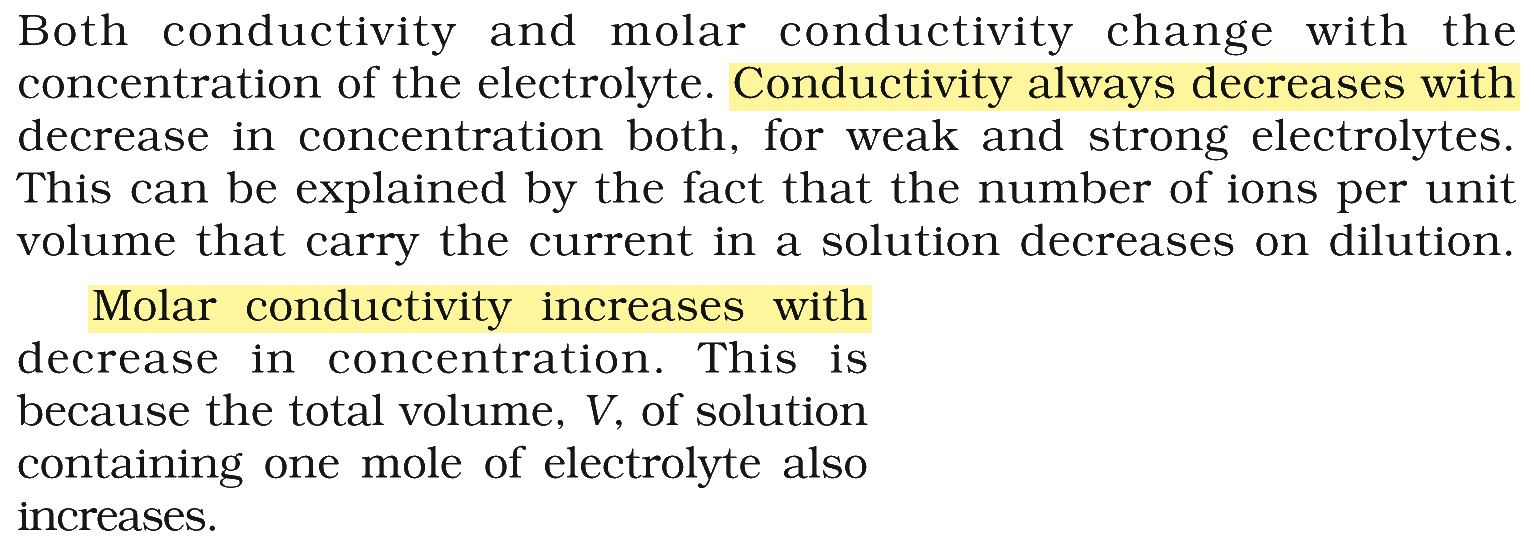
So Λm is a property of the solution, fixed by its concentration and temperature. On dilution, κ falls because there are fewer ions per cm3, but the volume containing 1 mol of electrolyte grows faster, so Λm increases. For a strong electrolyte, the interionic attraction weakens; for a weak electrolyte, the degree of dissociation increases.
(A) Area of cross section of electrode increases. — Incorrect. A larger area increases the conductance G of the cell, but κ and Λm of the solution stay the same.
(B) Distance between the electrode decreases. — Incorrect. This changes only the cell constant (l/A) and the measured conductance, not Λm.
(C) Concentration of the solution decreases. — Correct. On dilution, Λm increases, as explained above.
(D) Concentration of the solution increases. — Incorrect. A more concentrated solution has a lower Λm.
NCERT (2026-27 edition):
Variation of Conductivity and Molar Conductivity with Concentration