Solution of the differential equation \( y\,e^{\frac{x}{y}}dx+\left(y-x\,e^{\frac{x}{y}}\right)dy=0 \) is: (Consider \( \log x=\log_{e}x \))
Answer & explanation
Correct answer: option 3
The correct answer is Option (3) → \( e^{\frac{x}{y}}+\log y=C \): where \( C \) is an arbitrary constant
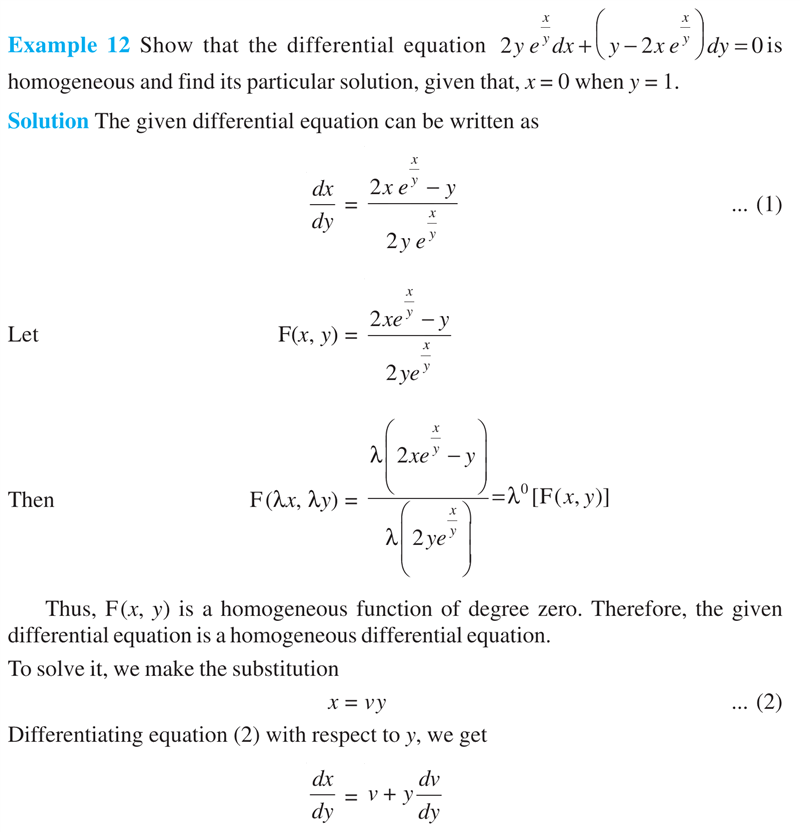
The equation is homogeneous, since it depends on \( x \) and \( y \) only through \( \frac{x}{y} \). Written for \( \frac{dx}{dy} \):
\( \displaystyle \frac{dx}{dy}=\frac{x\,e^{x/y}-y}{y\,e^{x/y}} \)
\( \displaystyle =\frac{x}{y}-e^{-x/y} \)
Put \( x=vy \), so that \( \frac{dx}{dy}=v+y\frac{dv}{dy} \):
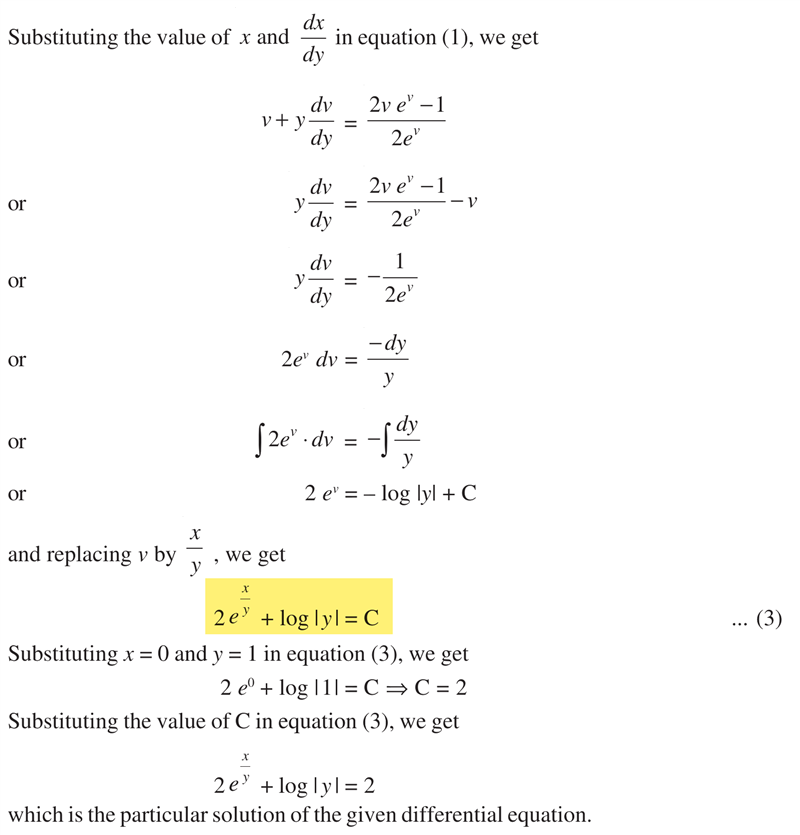
\( \displaystyle v+y\frac{dv}{dy}=v-e^{-v} \)
\( \displaystyle e^{v}\,dv=-\frac{dy}{y} \)
Integrating, \( e^{v}=-\log y+C \), that is
\( \displaystyle e^{x/y}+\log y=C \)
NCERT (2026-27 edition):
Homogeneous Differential Equations