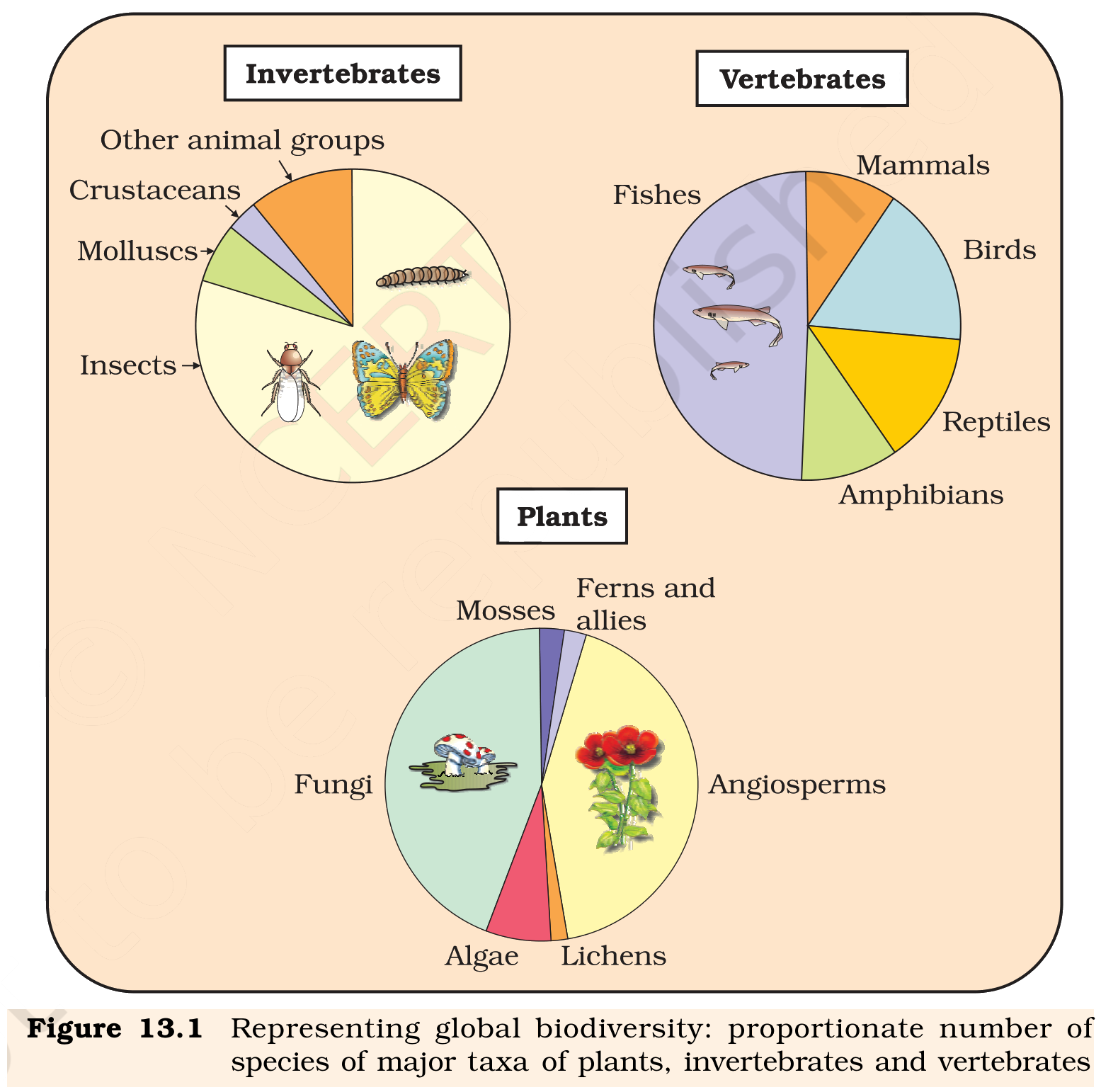
Arrange in increasing order of number of species to represent global biodiversity?
(A) Molluscs
(B) Crustaceans
(C) Insects
(D) Other animal groups
Choose the correct answer from the options given below:
Answer & explanation
Correct answer: option 3
The correct answer is Option (3) → (B), (A), (D), (C)
NCERT’s pie chart for invertebrates shows the share of species in each group. Read from the smallest slice to the largest.
(B) Crustaceans — first. They have the smallest slice of the four.
(A) Molluscs — second. Their slice is larger than that of crustaceans.
(D) Other animal groups — third. All the remaining groups together form a larger slice than molluscs.
(C) Insects — last. Insects are the most species-rich group, more than 70 per cent of all animal species.
Note: A similar question was also asked in CUET (UG) 2026 on 24-05-2026 (Slot 1).
NCERT Extract:
Biodiversity – “… Let us look at some interesting aspects about earth’s biodiversity based on the currently available species inventories. More than 70 per cent of all the species recorded are animals, while plants (including algae, fungi, bryophytes, gymnosperms and angiosperms) comprise no more than 22 per cent of the total. Among animals, insects are the most species-rich taxonomic group, making up more than 70 per cent of the total. … In Figure 13.1, biodiversity is depicted showing species number of major taxa.”