Read the passage carefully and answer the questions based on the passage:
Long Run Costs
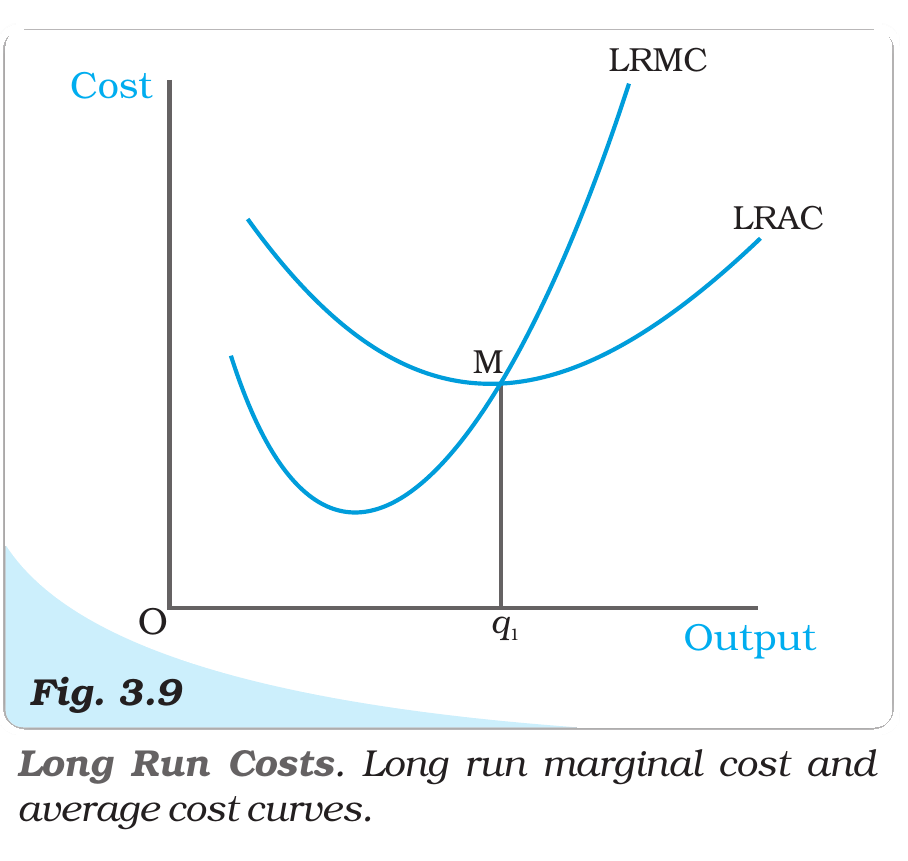
In the long run, all inputs are variable. There are no fixed costs. The total cost and the total variable cost therefore, coincide in the long run. Long run marginal cost is the change in total cost per unit of change in output. Increasing returns to scale implies that if we increase all the inputs by a certain proportion, output increases by more than that proportion. Decreasing returns to scale implies that if we want to increase the output by a certain proportion, inputs need to be increased by more than that proportion. Constant returns to scale implies a proportional increase in inputs resulting in a proportional increase in output. So the average cost remains constant as long as CRS operates. The LRAC curve is a 'U'-shaped curve. Its downward sloping part corresponds to IRS and upward rising part corresponds to DRS. At the minimum point of the LRAC curve, CRS is observed. For the first unit of output, both LRMC and LRAC are the same. Then, as output increases, LRAC initially falls, and then, after a certain point, it rises. As long as average cost is falling, marginal cost must be less than the average cost. When the average cost is rising, marginal cost must be greater than the average cost. LRMC cuts the LRAC curve from below at the minimum point of the LRAC.
The shape of the long-run average cost curve and long-run marginal cost curve is __________.
Answer & explanation
Correct answer: option 4
The correct answer is Option (4) → U shaped
Both long run curves are ‘U’-shaped. The long run average cost (LRAC) curve falls while increasing returns to scale operate, and rises while decreasing returns to scale operate. The long run marginal cost (LRMC) curve starts from the same point as LRAC, falls first and rises later.
Option (1) Only LRAC is U shaped. — Incorrect. LRMC also falls first and then rises, so it has the same shape.
Option (2) LRAC is U shaped and LRMC upward sloping. — Incorrect. Only the later part of LRMC slopes upward. While LRAC is falling at low output, LRMC is falling too.
Option (3) Rectangular hyperbola. — Incorrect. A rectangular hyperbola is a curve along which the product of the two values stays the same. It is the shape of the average fixed cost curve in the short run. In the long run there are no fixed costs.
Option (4) U shaped — Correct. Each curve first falls, reaches a lowest point and then rises.
NCERT (2026-27): “Shapes of the Long Run Cost Curves … It is argued that in a typical firm IRS is observed at the initial level of production. This is then followed by the CRS and then by the DRS. Accordingly, the LRAC curve is a ‘U’-shaped curve. Its downward sloping part corresponds to IRS and upward rising part corresponds to DRS. At the minimum point of the LRAC curve, CRS is observed. Let us check how the LRMC curve looks like. For the first unit of output, both LRMC and LRAC are the same. Then, as output increases, LRAC initially falls, and then, after a certain point, it rises. As long as average cost is falling, marginal cost must be less than the average cost. When the average cost is rising, marginal cost must be greater than the average cost. LRMC curve is therefore a ‘U’-shaped curve. It cuts the LRAC curve from below at the minimum point of the LRAC. Figure 3.9 shows the shapes of the long run marginal cost and the long run average cost curves for a typical firm.…”
|