CUETMOCK
  • Pricing
  • Mentors
Log inStart freeStart free mocks→

First test, then trust

Try a free CUET mock test.

Join 5,00,000+ students who rehearsed exam day on the exact NTA screen before sitting CUET. On the web and on Android.

Start free mocks →Get the Android app
CUETMOCK

India's #1 CUET Mock Test Platform. Original NCERT-based questions on the exact NTA exam screen — trusted by 5,00,000+ students since CUET 2022.

Get it onGoogle PlayScan to download the CUETMOCK app

Mock tests

  • CUET mock test series
  • Commerce mocks
  • Humanities (Arts) mocks
  • Science mocks
  • Languages & GAT mocks
  • Free practice questions
  • Pricing

Resources

  • CUET exam guide
  • CUET syllabus
  • Universities accepting CUET
  • Expert blogs
  • News & notifications
  • Webinars & counselling
  • CUET score calculator
  • How we estimate your rank
  • FAQs

Company

  • About us
  • Our leadership & team
  • Our toppers
  • Mentors
  • For schools
  • Contact us
  • Terms
  • Privacy
  • Refund policy

Talk to us

+91 7696 6630 56info@cuetmock.comWhatsApp us

Our other platforms

  • JEE Mock — For IIT-JEE aspirants
  • NEET Mock — For NEET aspirants

Newsletter

Exam updates, study material and offers — no spam.

© 2026 NYC Ventures Pvt. Ltd.

701-702, Royal Business Park, Zirakpur, Punjab - 140603

  • Terms of use
  • Privacy policy
  • Refund policy
  • Contact us

iCUETMOCK is an independent preparation platform, not affiliated with the National Testing Agency (NTA). Always check exam details on the official NTA website.

  • Home
  • Mock tests
  • CUET guide
  • Pricing
  • Log in
Home/Practice questions/Chemistry
ChemistryOrganic: Alcohols, Phenols and Ethers

Match the reactions (List-I) with reagents (List-II) used to get the…

Match the reactions (List-I) with reagents (List-II) used to get the product.

LIST-I
(Reactions)
LIST-II
(Reagents)
A.Reaction AI.H+/ H2O
B.Reaction BII.BH3/ H2O2, OH−
C.Reaction CIII.Lithium aluminum hydride/ H2O
D.Reaction DIV.Sodium borohydride

Choose the correct answer from the options given below:

Answer & explanation+

Correct answer: option 4

The correct answer is Option (4) → A-III, B-I, C-IV, D-II

Alcohols are made in two main ways. One is reducing a C=O group, where \( \ce{NaBH4} \) is the milder reagent and \( \ce{LiAlH4} \) the stronger one. The other is adding water across a C=C bond, where acid-catalysed hydration follows Markovnikov’s rule and hydroboration–oxidation gives the anti-Markovnikov product.

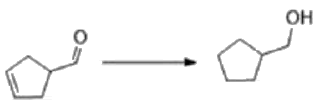
  • A. Aldehyde → primary alcohol — This matches III. Lithium aluminum hydride/ H2O. \( \ce{LiAlH4} \) reduces –CHO to –\( \ce{CH2OH} \); A–III follows by elimination, because the products of B, C and D fix their reagents.

        \( \displaystyle \ce{R-CHO} \xrightarrow[\text{(ii) }\ce{H2O}]{\text{(i) }\ce{LiAlH4}} \ce{R-CH2OH} \)

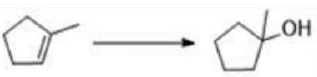
  • B. 1-Methylcyclopentene → 1-methylcyclopentanol — This matches I. H+/ H2O. In acid-catalysed hydration, \( \ce{H^{+}} \) adds to the less substituted carbon and forms the more stable tertiary carbocation, so the –OH ends up on the carbon carrying the methyl group (Markovnikov addition).

        \( \displaystyle \text{1-methylcyclopentene} \xrightarrow{\ce{H^+}/\ce{H2O}} \text{1-methylcyclopentanol} \)

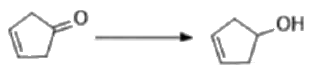
  • C. Cyclopent-2-en-1-one → cyclopent-2-en-1-ol — This matches IV. Sodium borohydride. The C=O is conjugated with the C=C. The mild reagent \( \ce{NaBH4} \) reduces only the C=O and leaves the double bond intact.

        \( \displaystyle \text{cyclopent-2-en-1-one} \xrightarrow{\ce{NaBH4}} \text{cyclopent-2-en-1-ol} \)

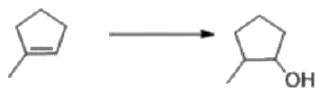
  • D. 1-Methylcyclopentene → 2-methylcyclopentanol — This matches II. BH3/ H2O2, OH−. Boron adds to the less substituted carbon and is then replaced by –OH, so the –OH ends up on the carbon next to the methyl group (anti-Markovnikov addition).

        \( \displaystyle \text{1-methylcyclopentene} \xrightarrow[\text{(ii) }\ce{H2O2},\ \ce{OH^-}]{\text{(i) }\ce{BH3}} \text{2-methylcyclopentanol} \)

Note: It seems that there is a mistake in the original NTA paper. In reaction A, the product is drawn with a saturated ring (cyclopentylmethanol); it should keep the ring double bond (cyclopent-3-en-1-ylmethanol), because \( \ce{LiAlH4} \) reduces the C=O group but does not reduce an isolated C=C bond.

Advertisement

Practise more on Organic: Alcohols, Phenols and Ethers

Chapter-wise mocks on the real NTA exam screen, with solutions and your rank. Your first mocks are free.

Start free mocks →

Advertisement

Next questions

  1. Suppose the price elasticity of demand for a good is (-)1. At a price of ₹ 4 per unit, demand for the good is 40 units. Suppose the price o…Economics · Micro Economics: Theory of Consumer behaviour
  2. Where is Birth of Poetry currently displayed?Fine Arts · The Modern Indian Art
  3. Which of the metal is used in catalytic hydrogenation?Chemistry · Inorganic: D and F Block Elements
  4. Select the correct indirect form of the given sentence. Reema said to her partner. "You will have to dance in front of a large gathering".English · Direct/indirect
  5. Raj can use the following off-the-job training methods for newly recruited employees except:Business Studies · Staffing
  6. Ravi sell his goods at 10% Profit. Had he purchase it for 20% less and sold it for ₹20 more then he would gain 40%. Find initial cost price.General Aptitude Test · Numerical Ability
  7. Maths. Section A · Differential Equations
  8. In the context of the passage what does it mean to 'earn a thick ear'?English · Comprehension - (Narrative / Factual)
  9. What is the difference between TODAY() and NOW() Function?Accountancy Part C · Spreadsheet
  10. The value of ∫_10^30d xMaths. Section A · Definite Integration