CUETMOCK
  • Pricing
  • Mentors
Log inStart freeStart free mocks→

First test, then trust

Try a free CUET mock test.

Join 5,00,000+ students who rehearsed exam day on the exact NTA screen before sitting CUET. On the web and on Android.

Start free mocks →Get the Android app
CUETMOCK

India's #1 CUET Mock Test Platform. Original NCERT-based questions on the exact NTA exam screen — trusted by 5,00,000+ students since CUET 2022.

Get it onGoogle PlayScan to download the CUETMOCK app

Mock tests

  • CUET mock test series
  • Browse all papers
  • Commerce mocks
  • Humanities (Arts) mocks
  • Science mocks
  • Languages & GAT mocks
  • Free practice questions
  • Pricing

Resources

  • CUET exam guide
  • CUET syllabus
  • Universities accepting CUET
  • Expert blogs
  • News & notifications
  • Webinars & counselling
  • CUET score calculator
  • How we estimate your rank
  • FAQs

Company

  • About us
  • Our leadership & team
  • Our toppers
  • Mentors
  • For schools
  • Contact us
  • Terms
  • Privacy
  • Refund policy

Talk to us

+91 7696 6630 56info@cuetmock.comWhatsApp us

Our other platforms

  • JEE Mock — For IIT-JEE aspirants
  • NEET Mock — For NEET aspirants

Newsletter

Exam updates, study material and offers — no spam.

© 2026 NYC Ventures Pvt. Ltd.

701-702, Royal Business Park, Zirakpur, Punjab - 140603

  • Terms of use
  • Privacy policy
  • Refund policy
  • Contact us

iCUETMOCK is an independent preparation platform, not affiliated with the National Testing Agency (NTA). Always check exam details on the official NTA website.

  • Home
  • Mock tests
  • CUET guide
  • Pricing
  • Log in
Home/Practice questions/Economics
EconomicsMicro Economics: Theory of Consumer behaviour

Suppose the price elasticity of demand for a good is (-)1. At a price…

Suppose the price elasticity of demand for a good is (-)1. At a price of ₹ 4 per unit, demand for the good is 40 units. Suppose the price of the good increases to ₹ 6 per unit, and as a result, the demand for the good will be ____________.

Answer & explanation+

Correct answer: option 2

The correct answer is Option (2) → 20 units

Given:

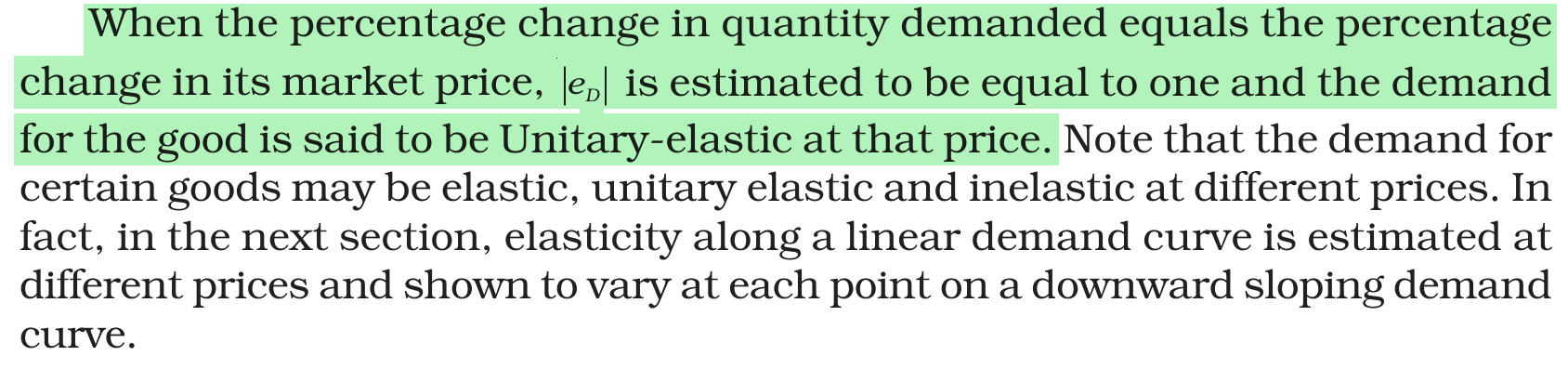
Price elasticity of demand, eD = −1

Old price = ₹ 4, new price = ₹ 6

Old demand = 40 units

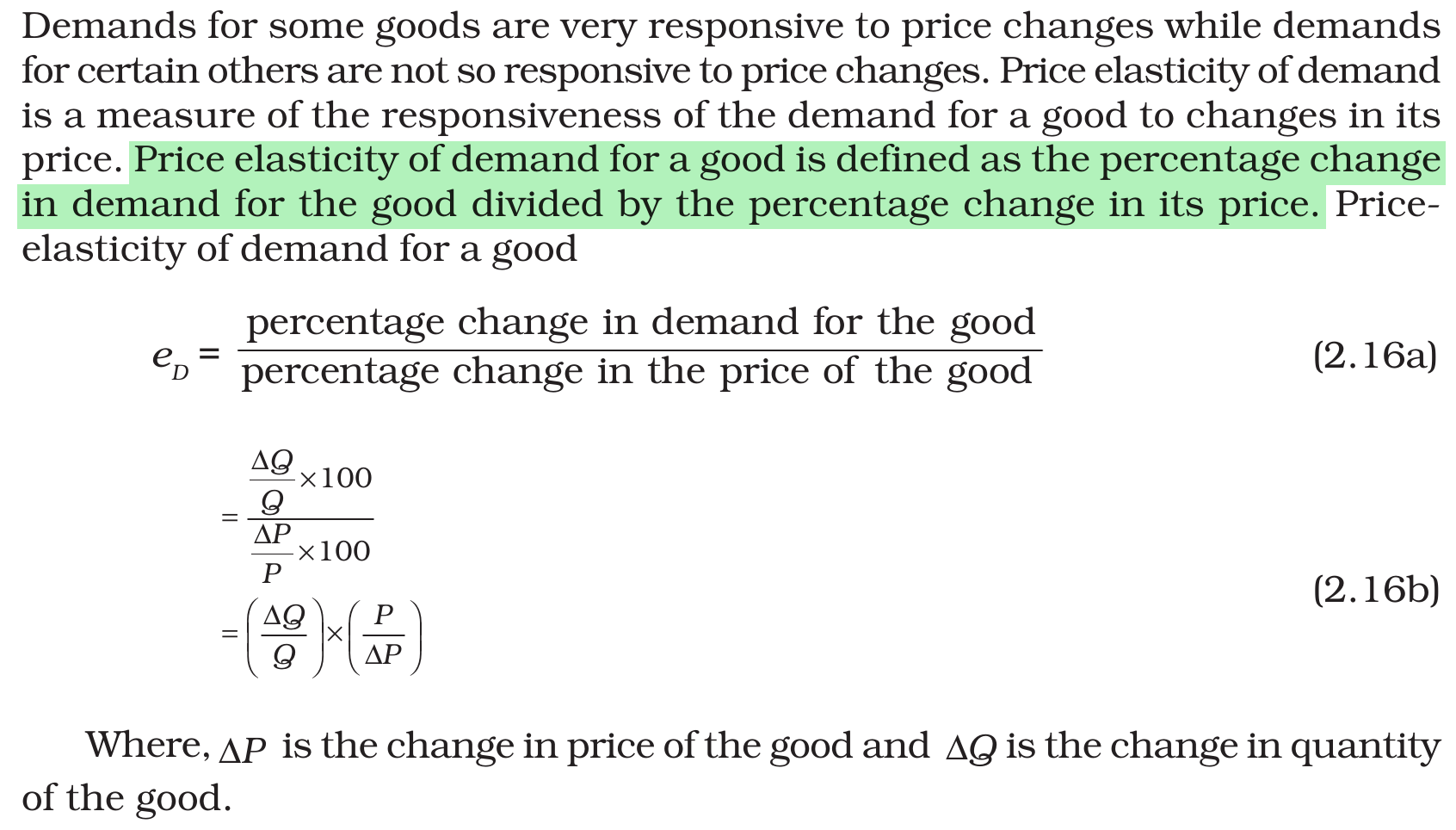
Price elasticity of demand is the percentage change in demand divided by the percentage change in price:

eD = (% change in demand) ÷ (% change in price)

% change in price = (6 − 4)/4 × 100 = 50%

−1 = (% change in demand) ÷ 50

% change in demand = −50%

Fall in demand = 50% of 40 = 20 units

New demand = 40 − 20 = 20 units

NCERT (2026-27): Introductory Microeconomics — Chapter 2: Theory of Consumer Behaviour

NCERT extract

NCERT extract

Advertisement

Practise more on Micro Economics: Theory of Consumer behaviour

Chapter-wise mocks on the real NTA exam screen, with solutions and your rank. Your first mocks are free.

Start free mocks →

Advertisement

Next questions

  1. Where is Birth of Poetry currently displayed?Fine Arts · The Modern Indian Art
  2. Which of the metal is used in catalytic hydrogenation?Chemistry · Inorganic: D and F Block Elements
  3. Select the correct indirect form of the given sentence. Reema said to her partner. "You will have to dance in front of a large gathering".English · Direct/indirect
  4. Raj can use the following off-the-job training methods for newly recruited employees except:Business Studies · Staffing
  5. Ravi sell his goods at 10% Profit. Had he purchase it for 20% less and sold it for ₹20 more then he would gain 40%. Find initial cost price.General Aptitude Test · Numerical Ability
  6. Maths. Section A · Differential Equations
  7. In the context of the passage what does it mean to 'earn a thick ear'?English · Comprehension - (Narrative / Factual)
  8. What is the difference between TODAY() and NOW() Function?Accountancy Part C · Spreadsheet
  9. The value of ∫_10^30d xMaths. Section A · Definite Integration
  10. Assertion (A): A group may be defined as an organised system of one or more individuals who are interacting and interdependent.Reason (R):…Psychology · Social Influence and Group Processes