
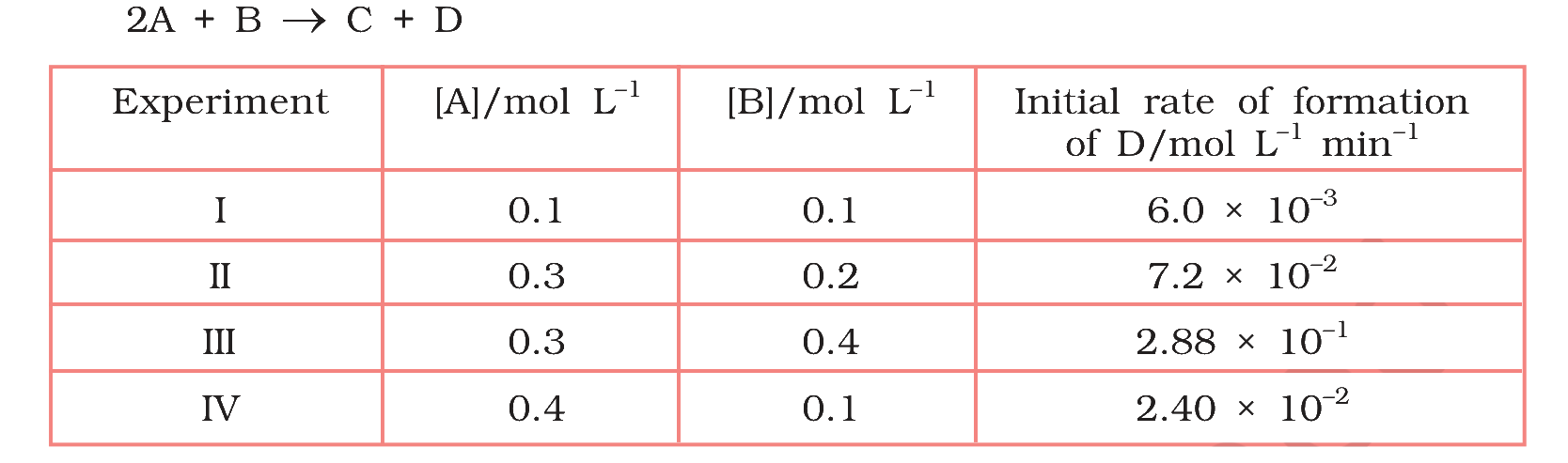
For the reaction 2A + B → C + D, the table gives the initial rate of formation of D in four experiments at the same temperature.
Using experiments II and III only, what is the order of the reaction with respect to B?
Answer & explanation
Correct answer: option 1
The correct answer is Option (1) → 2
In experiments II and III, [A] is kept the same (0.3 mol L−1) and [B] is doubled (0.2 → 0.4 mol L−1). So any change in the rate is due to B alone. If the order with respect to B is y, the rate changes by a factor of 2y.
\( \displaystyle \frac{\text{Rate}_{\text{III}}}{\text{Rate}_{\text{II}}} = \frac{2.88 \times 10^{-1}}{7.2 \times 10^{-2}} = 4 = 2^{y} \)
\( \displaystyle 2^{y} = 2^{2} \Rightarrow y = 2 \)
NCERT (2026-27 edition):
3.2.2 Rate Expression and Rate Constant – “We can measure the rate of this reaction as a function of initial concentrations either by keeping the concentration of one of the reactants constant and changing the concentration of the other reactant or by changing the concentration of both the reactants.”
3.2.3 Order of a Reaction – “In the rate equation (3.4) Rate = k [A]x [B]y x and y indicate how sensitive the rate is to the change in concentration of A and B. Sum of these exponents, i.e., x + y in (3.4) gives the overall order of a reaction whereas x and y represent the order with respect to the reactants A and B respectively.”
Initial rate of formation of D for the reaction 2A + B → C + D