
To find the focal length of a convex lens, a student obtains the real, inverted and magnified image on the screen as shown in the figure below
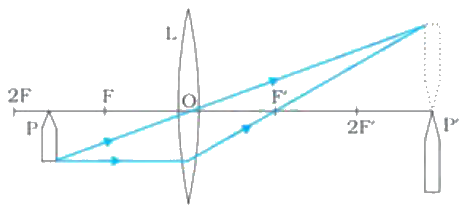
Now the whole set up is immersed in water without disturbing the object and position of the screen. What will be student's observation on the screen?
Answer & explanation
Correct answer: option 3
The correct answer is Option (3) → Image disappears from the screen
A glass convex lens in water has a longer focal length, because its power depends on the ratio of its refractive index to that of the surrounding medium (lens maker's formula).
\( \displaystyle \frac{1}{f} = \left(\frac{\mu_{g}}{\mu_{m}} - 1\right)\left(\frac{1}{R_{1}} - \frac{1}{R_{2}}\right) \)
Taking \( \mu_{g} = 1.5 \) for glass and \( \mu_{w} = 1.33 \) for water:
\( \displaystyle \text{in air: } \frac{\mu_{g}}{\mu_{a}} - 1 = 0.5 \qquad \text{in water: } \frac{1.5}{1.33} - 1 \approx 0.13 \)
\( \displaystyle \frac{f_{\mathrm{water}}}{f_{\mathrm{air}}} = \frac{0.5}{0.13} \approx 4 \)
In the figure the image is real and magnified, which happens only when the object lies between \( f \) and \( 2f \) of the lens, so \( u \lt 2f \). In water \( f \) becomes about four times larger, so \( u \lt f_{\mathrm{water}} \): the object is now inside the focal length. A convex lens then forms a virtual image, which cannot be caught on a screen. The image disappears from the screen.