Read the passage and answer the questions:
Vijayanagara Empire: Architecture
In terms of temple architecture, by this period certain new features were in evidence. These included structures of immense scale that must have been a mark of imperial authority, best exemplified by the raya gopurams or royal gateways that often dwarfed the towers on the central shrines, and signalled the presence of the temple from a great distance. They were also probably meant as reminders of the power of kings, able to command the resources, techniques and skills needed to construct these towering gateways. Other distinctive features include mandapas or pavilions and long, pillared corridors that often ran around the shrines within the temple complex. Let us look at two temples more closely – the Virupaksha temple and the Vitthala temple. The Virupaksha temple was built over centuries. While inscriptions suggest that the earliest shrine dated to the ninth-tenth centuries, it was substantially enlarged with the establishment of the Vijayanagara Empire. The hall in front of the main shrine was built by Krishnadeva Raya to mark his accession. This was decorated with delicately carved pillars. He is also credited with the construction of the eastern gopuram. These additions meant that the central shrine came to occupy a relatively small part of the complex. The halls in the temple were used for a variety of purposes. Some were spaces in which the images of gods were placed to witness special programmes of music, dance, drama, etc. Others were used to celebrate the marriages of deities, and yet others were meant for the deities to swing in. Special images, distinct from those kept in the small central shrine, were used on these occasions.
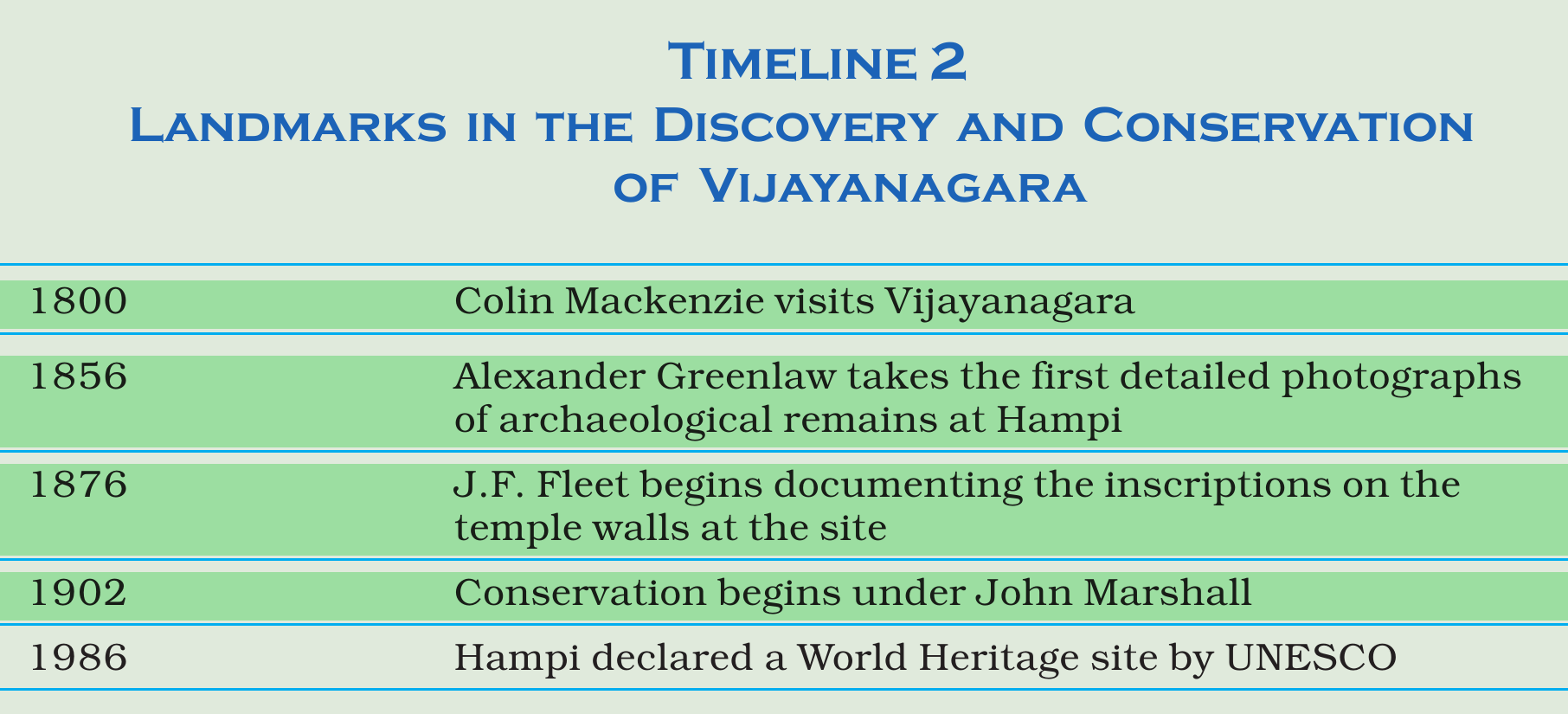
Match the LIST-I with LIST-II
| LIST-I Year | LIST-II Discovery and Conservation of Vijayanagara | ||
| A. | 1856 | I. | Conservation begins under John Marshall |
| B. | 1800 | II. | Alexander Greenlaw takes photographs at Hampi |
| C. | 1876 | III. | Colin Mackenzie visits Vijayanagara |
| D. | 1902 | IV. | J.F. Fleet begins documenting inscriptions on the temple walls |
Choose the correct answer from the options given below:
Answer & explanation
Correct answer: option 2
The correct answer is Option (2) → A - II, B - III, C - IV, D - I
(A) 1856 — this matches (II) Alexander Greenlaw takes photographs at Hampi. From 1856 photographers began to record the monuments, and Greenlaw took the first detailed photographs of the remains at Hampi, which let scholars study them.
(B) 1800 — this matches (III) Colin Mackenzie visits Vijayanagara. The ruins at Hampi were brought to light in 1800 by Colonel Colin Mackenzie, an engineer and antiquarian of the East India Company, who prepared the first survey map of the site.
(C) 1876 — this matches (IV) J.F. Fleet begins documenting inscriptions on the temple walls. Fleet began recording the inscriptions on the temple walls at the site, which historians later read alongside travellers’ accounts and literature in Telugu, Kannada, Tamil and Sanskrit.
(D) 1902 — this matches (I) Conservation begins under John Marshall. Conservation of the site began in 1902 under John Marshall; in 1986 Hampi was declared a World Heritage site by UNESCO.
NCERT (2025-26): “1. The Discovery of Hampi … The ruins at Hampi were brought to light in 1800 by an engineer and antiquarian named Colonel Colin Mackenzie. An employee of the English East India Company, he prepared the first survey map of the site. Much of the initial information he received was based on the memories of priests of the Virupaksha temple and the shrine of Pampadevi. Subsequently, from 1856, photographers began to record the monuments which enabled scholars to study them. As early as 1836 epigraphists began collecting several dozen inscriptions found at this and other temples at Hampi. In an effort to reconstruct the history of the city and the empire, historians collated information from these sources with accounts of foreign travellers and other literature written in Telugu, Kannada, Tamil and Sanskrit.”
|