Question is based on following passage:
Methyl nitrile is hydrolysed to carboxylic acid in the presence of \(H^+\) or \(OH^-\) as catalyst. An intermediate compound [A] is formed during this reaction.
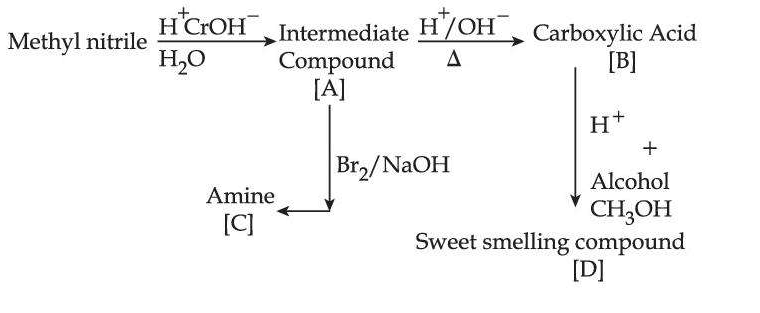
Converting [A] into [C] is called:
Answer & explanation
Correct answer: option 2
The correct answer is Option (2) → Hoffmann Degradation reaction
[A] is ethanamide. Heating an amide with bromine and sodium hydroxide gives a primary amine with one carbon atom less; the alkyl group migrates from the carbonyl carbon to nitrogen:
\( \displaystyle \ce{CH3CONH2 + Br2 + 4NaOH -> CH3NH2 + Na2CO3 + 2NaBr + 2H2O} \)
This is the Hoffmann bromamide degradation reaction; [C] is methanamine. The other three options are other routes connected with amines:
Option (1) Ammonolysis — Incorrect. An alkyl halide reacts with ammonia; no amide or \( \ce{Br2} \)/NaOH is involved:
\( \displaystyle \ce{R-X + NH3 -> R-NH2 + HX} \)
Option (3) Carbylamine reaction — Incorrect. A test for primary amines, not a way to make them from amides:
\( \displaystyle \ce{R-NH2 + CHCl3 + 3KOH} \xrightarrow{\Delta} \ce{R-NC + 3KCl + 3H2O} \)
Option (4) Gabriel phthalimide reaction — Incorrect. It makes primary amines from phthalimide and an alkyl halide, not from an amide with \( \ce{Br2} \)/NaOH:
\( \displaystyle \ce{C6H4(CO)2NH} \xrightarrow{\text{alc. }\ce{KOH}} \ce{C6H4(CO)2N^-K+} \xrightarrow{\ce{R-X}} \ce{C6H4(CO)2N-R} \xrightarrow{\ce{NaOH(aq)}} \ce{R-NH2 + C6H4(COONa)2} \)
NCERT (2026-27 edition):
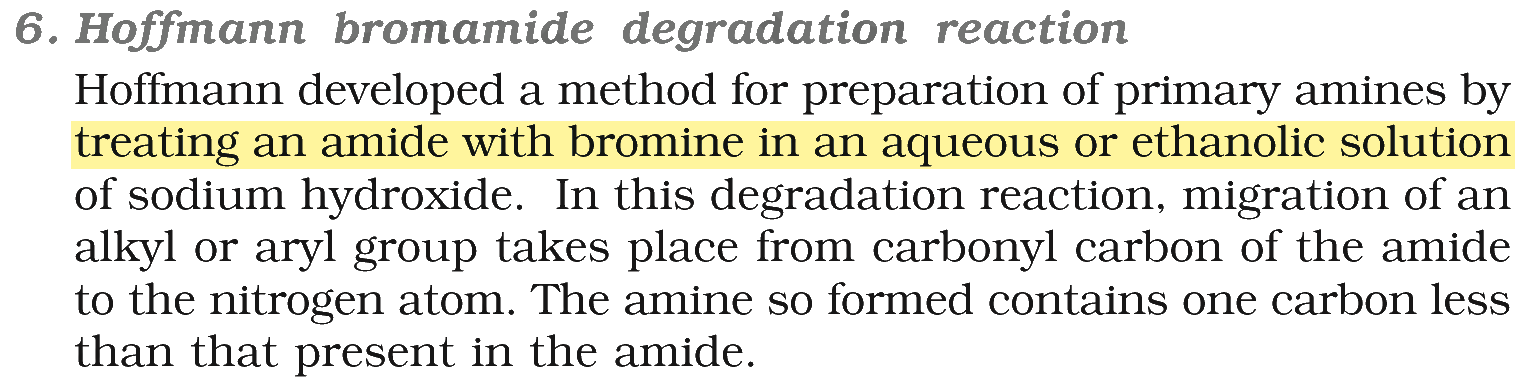
Hoffmann Bromamide Degradation Reaction