A and B throw a die alternatively till one of them gets a number more than 4 and wins the game. Then the probability of winning the game by B, if A starts first:
Answer & explanation
Correct answer: option 1
The correct answer is Option (1) → \(\displaystyle\frac{2}{5}\)
A number more than 4 means 5 or 6, so on each throw
\( \displaystyle P(\text{win}) = \frac{2}{6} = \frac{1}{3},\quad P(\text{not win}) = \frac{2}{3} \)
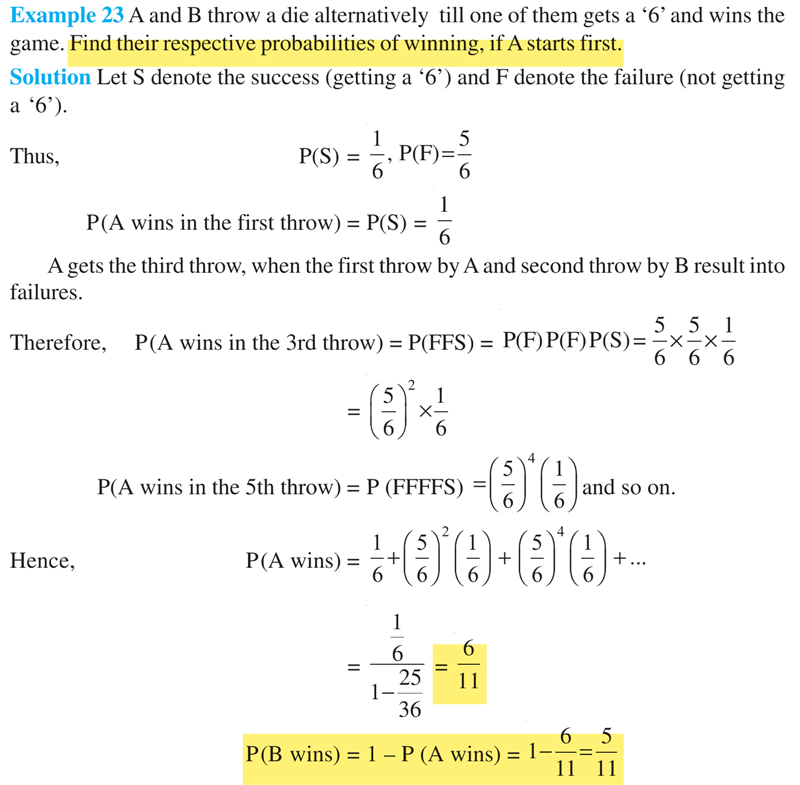
A throws 1st, 3rd, 5th, …; B throws 2nd, 4th, 6th, …. B wins on the 2nd throw if A fails and B succeeds, on the 4th throw if A, B, A fail and B succeeds, and so on:
\( \displaystyle P(B) = \frac{2}{3}\cdot\frac{1}{3} + \left(\frac{2}{3}\right)^3\cdot\frac{1}{3} + \left(\frac{2}{3}\right)^5\cdot\frac{1}{3} + \cdots \)
This is an infinite geometric series with first term \(\frac{2}{9}\) and common ratio \(\left(\frac{2}{3}\right)^2 = \frac{4}{9}\):
\( \displaystyle P(B) = \frac{\frac{2}{9}}{1 - \frac{4}{9}} \)
\( \displaystyle = \frac{2}{9}\times\frac{9}{5} = \frac{2}{5} \)
Why the other options are incorrect
Option (2) \(\displaystyle\frac{3}{5}\) — Incorrect. This is the probability that A wins: \(1 - \frac{2}{5} = \frac{3}{5}\). A has the advantage of throwing first.
Option (3) \(\displaystyle\frac{1}{5}\) — Incorrect. B’s probability of winning is \(\frac{2}{5}\), not \(\frac{1}{5}\).
Option (4) \(\displaystyle\frac{4}{5}\) — Incorrect. B’s probability of winning is \(\frac{2}{5}\); it cannot exceed A’s \(\frac{3}{5}\), since A throws first.
NCERT (2026-27 edition):
Probability