
In the following diagrams, which will have zero torque on the current loop:
Answer & explanation
Correct answer: option 4
The correct answer is Option (4)
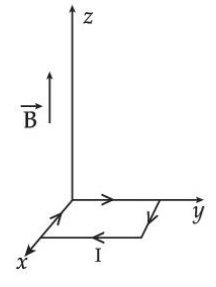
The torque on a current loop is \( \vec{\tau} = \vec{m}\times\vec{B} \), where the magnetic moment \( \vec{m} = I\vec{A} \) is along the normal of the loop. The torque is zero when \( \vec{m} \) is parallel or anti-parallel to \( \vec{B} \), that is, when the plane of the loop is perpendicular to the field.
The field \( \vec{B} \) is along \( +z \) in every diagram. In Option (4) the loop lies in the \( xy \)-plane, so its normal is along \( z \), parallel to \( \vec{B} \), and \( \tau = 0 \).
Why the other options are incorrect
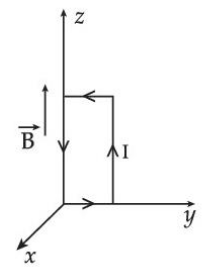
Option (1) — Incorrect. The loop lies in a vertical plane containing the \( z \)-axis, so its normal is perpendicular to \( \vec{B} \) and the torque is the maximum value \( IAB \).
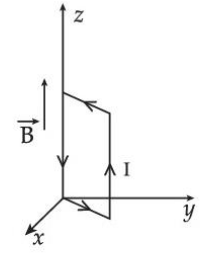
Option (2) — Incorrect. The loop is tilted and also has sides along \( z \); its normal is not along \( \vec{B} \), so the torque is not zero.
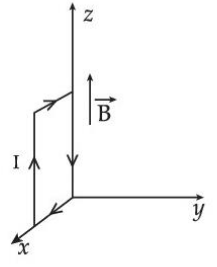
Option (3) — Incorrect. The loop lies in a vertical plane, so its normal is perpendicular to \( \vec{B} \) and the torque is the maximum value.
NCERT (2026-27):
Torque on Current Loop, Magnetic Dipole – “… We define the magnetic moment of the current loop as,
\( \displaystyle \mathbf{m} = I\mathbf{A} \qquad (4.22) \)
where the direction of the area vector A is given by the right-hand thumb rule and is directed into the plane of the paper in Fig. 4.18. … From Eq. (4.23), we see that the torque τ vanishes when m is either parallel or antiparallel to the magnetic field B.”