Which of the following term means tracing the descent from father to son, grandson, and so on?
Answer & explanation
Correct answer: option 1
The correct answer is Option (1) → Patriliny
Option (1) Patriliny — Correct. Patriliny means tracing descent from father to son, grandson and so on. Most ruling dynasties claimed to follow this system from about the sixth century BCE, and the Mahabharata reinforced the idea that it was valuable.
Option (2) Matriliny — Incorrect. Matriliny is the term used when descent is traced through the mother, not the father.
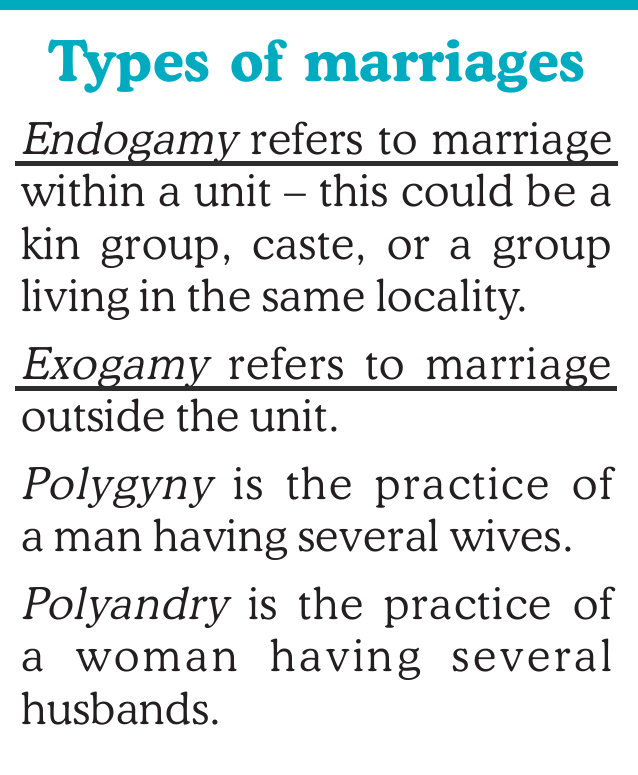
Option (3) Endogamy — Incorrect. Endogamy is a rule of marriage, not of descent: it refers to marriage within a unit, such as a kin group, a caste or a group living in the same locality.
Option (4) Exogamy — Incorrect. Exogamy is also a rule of marriage: it refers to marriage outside the unit.
Note: A same/similar question was asked in CUET (UG) in the papers below.
| 2026 | 2025 | 2024 | 2023 | 2022 |
| – | 22-05 S1 | – | – | 16-07 S1* |
* A similar question.
NCERT (2025-26): “2.2 The ideal of patriliny … Can we identify points when kinship relations changed? At one level, the Mahabharata is a story about this. It describes a feud over land and power between two groups of cousins, the Kauravas and the Pandavas, who belonged to a single ruling family, that of the Kurus, a lineage dominating one of the janapadas (Chapter 2, Map 1). Ultimately, the conflict ended in a battle, in which the Pandavas emerged victorious. After that, patrilineal succession was proclaimed. While patriliny had existed prior to the composition of the epic, the central story of the Mahabharata reinforced the idea that it was valuable. Under patriliny, sons could claim the resources (including the throne in the case of kings) of their fathers when the latter died. Most ruling dynasties (c. sixth century BCE onwards) claimed to follow this system… Patriliny means tracing descent from father to son, grandson and so on. Matriliny is the term used when descent is traced through the mother.”
|