
Read the given passage and answer the following question :
Biogas is a mixture of gases (containing predominantly methane) produced by the microbial activity and which may be used as fuel. Microbes produce different types of gaseous end-products during growth and metabolism. The type of the gas produced depends upon the microbes and the organic substrates they utilise. In the examples cited in relation to fermentation of dough, cheese making and production of beverages, the main gas produced was CO2. However, certain bacteria, which grow anaerobically on cellulosic material, produce large amount of methane along with CO2 and H2. These bacteria are collectively called methanogens, and one such common bacterium is Methanobacterium. These bacteria are commonly found in the anaerobic sludge during sewage treatment. These bacteria are also present in the rumen (a part of stomach) of cattle. A lot of cellulosic material present in the food of cattle is also present in the rumen. In rumen, these bacteria help in the breakdown of cellulose and play an important role in the nutrition of cattle. Thus, the excreta (dung) of cattle, commonly called gobar, is rich in these bacteria. Dung can be used for generation of biogas, commonly called gobar gas. The technology of biogas production was developed in India mainly due to the efforts of Indian Agricultural Research Institute (IARI) and Khadi and Village Industries Commission (KVIC).
Consider the following statements about a typical biogas plant:
A. It consists of a concrete tank in which bio-wastes are collected and a slurry of dung is fed.
B. A floating cover placed over the slurry keeps on rising as gas is produced in the tank due to microbial activity.
C. The spent slurry is removed through the same outlet that supplies biogas to nearby houses.
D. The spent slurry may be used as fertiliser.
Choose the correct answer from the options given below:
Answer & explanation
Correct answer: option 3
The correct answer is Option (3) → A, B and D only
The passage explains how methanogens in cattle dung make biogas, but it does not describe the plant itself. A biogas plant is a closed tank in which methanogens break down dung anaerobically. The gas collects under a cover and is piped out, and the leftover slurry is taken out separately.
Statement A: It consists of a concrete tank in which bio-wastes are collected and a slurry of dung is fed. — True. The main part of the plant is a concrete tank (the digester). Bio-wastes and a slurry of dung are fed into it.
Statement B: A floating cover placed over the slurry keeps on rising as gas is produced in the tank due to microbial activity. — True. The cover (gas-holder) floats on the slurry. As the microbes produce gas, the gas collects under the cover and pushes it up.
Statement C: The spent slurry is removed through the same outlet that supplies biogas to nearby houses. — False. The plant has two separate outlets. One is connected to a pipe that supplies biogas to nearby houses. The spent slurry is removed through another outlet.
Statement D: The spent slurry may be used as fertiliser. — True. The slurry left after gas production is not wasted; it may be used as fertiliser in the fields.
NCERT Extract:
Microbes in Production of Biogas – “… The biogas plant consists of a concrete tank (10-15 feet deep) in which bio-wastes are collected and a slurry of dung is fed. A floating cover is placed over the slurry, which keeps on rising as the gas is produced in the tank due to the microbial activity. The biogas plant has an outlet, which is connected to a pipe to supply biogas to nearby houses. The spent slurry is removed through another outlet and may be used as fertiliser.”
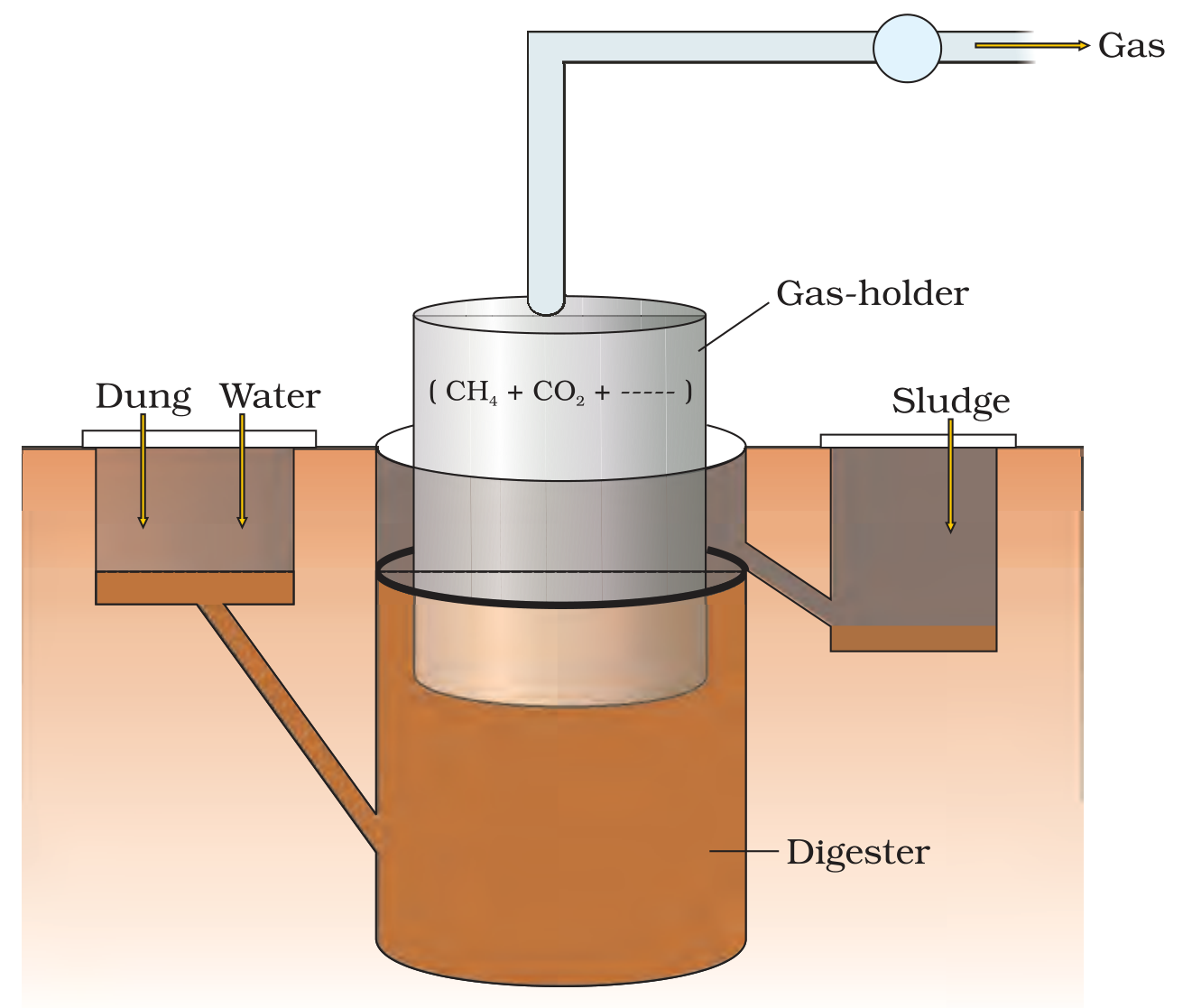
Figure 8.8 A typical biogas plant