
In order to supplement daily diet, a person wishes to take some X and some wishes Y tablets. The contents of iron, calcium and vitamins in X and Y (in milligrams per tablet) are given as below:
|
Tablets |
Iron |
Calcium |
Vitamin |
|
X |
6 |
3 |
2 |
|
Y |
2 |
3 |
4 |
The person needs at least 18 milligrams of iron, 21 milligrams of calcium and 16 milligram of vitamins. The price of each tablet of X and Y is Rs 2 and Re 1 respectively. How many tablets of each should the person take inorder to satisfy the above requirement at the minimum cost?
Answer & explanation
Correct answer: option 2
The correct answer is Option (2) → 1 tablet of X, 6 tablets of Y; Cost: Rs 8
Let there be x units of tablet X and y units of tablet Y
So, according to the given information, we have
$6x + 2y ≥18⇒ 3x + y ≥ 9$ ...(i)
|
x |
0 |
3 |
|
y |
9 |
0 |
$3x + 3y ≥21⇒x+y≥7$ ...(ii)
|
x |
0 |
7 |
|
y |
7 |
0 |
$2x+4y≥16⇒x+2y≥ 8$ ...(iii)
|
x |
0 |
8 |
|
y |
4 |
0 |
$x≥0, y ≥0$ ...(iv)
The price of each table of X type is 2 and that of y is ₹1.
So, the required LPP is
Minimise $Z = 2x + y$ subject to the constraints
$3x+y≥9,x+y≥7, x+2y≥8, x≥0,y≥0$
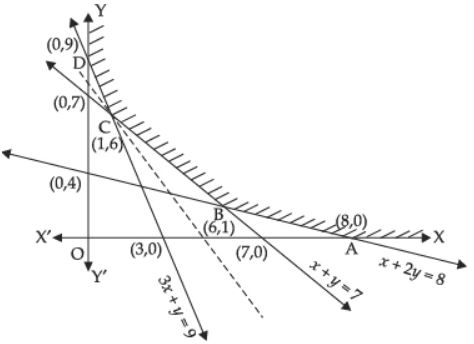
On solving (ii) and (iii) we get $x = 6$ and $y = 1$
On solving (i) and (ii) we get $x = 1$ and $y = 6$
From the graph, we see that the feasible region ABCD is unbounded whose corner points are A(8, 0), B(6, 1), C(1, 6) and D(0, 9).
Let us evaluate the value of Z
|
Corner points |
Value of Z=2x+y |
|
A(8, 0) |
$Z=2(8)+0=16$ |
|
B(6, 1) |
$Z=2(6)+1=13$ |
|
C(1, 6) |
$Z=2(1)+6=8$ ← Minimum |
|
D(0, 9) |
$Z=2(0)+9=9$ |
Here, we see that 8 is the minimum value of Z at (1, 6) but the feasible region is
unbounded. So, 8 may or may not be the minimum value of Z.
To confirm it, we will draw a graph of inequality $2x + y < 8$ and check if it has a common point.
We see from the graph that there is no common point on the line.
Hence, the minimum value of Z is 8 at (1, 6).
Tablet X = 1
Table Y = 6.