What would be the correct structure of thymine base?
Answer & explanation
Correct answer: option 2
The correct answer is Option (2) → thymine (5-methyluracil)
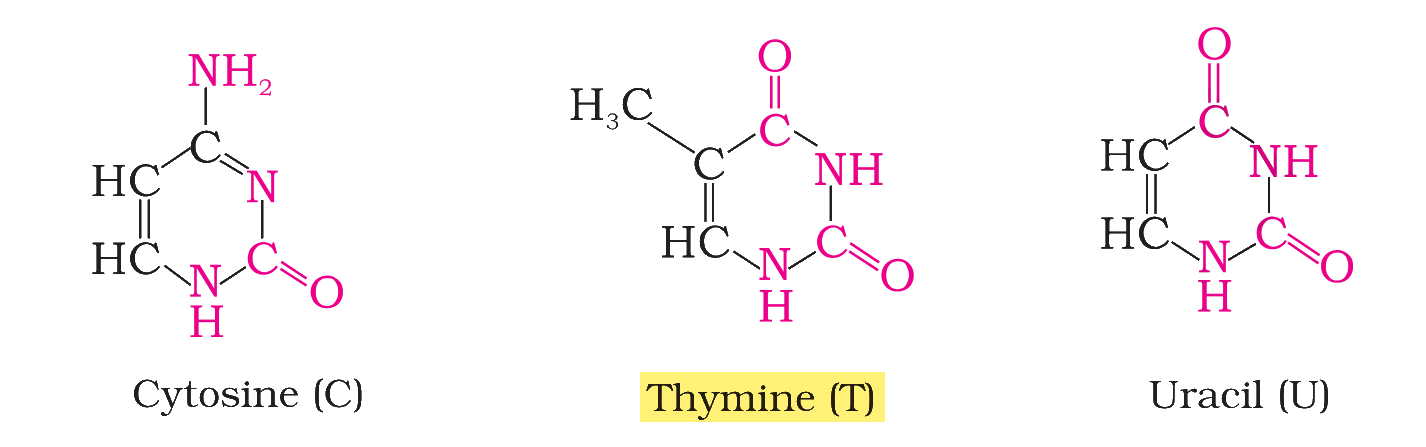
The bases of nucleic acids are of two kinds. The purines, adenine (A) and guanine (G), have two fused rings. The pyrimidines, cytosine (C), thymine (T) and uracil (U), have a single six-membered ring with two N atoms (at positions 1 and 3). DNA contains A, G, C and thymine; RNA contains A, G, C and uracil in place of thymine.
Thymine and uracil have the same ring with two C=O groups (at C2 and C4) and two N–H groups. The only difference is that thymine carries a methyl group at C5, the ring carbon next to the C4=O group. So thymine is 5-methyluracil, and its structure is the one in Option (2).
Why the other options are incorrect
Option (1) cytosine — Incorrect. This ring has an –NH2 group at C4 in place of the C=O group and only one C=O (at C2). That is cytosine, found in both DNA and RNA.
Option (3) uracil — Incorrect. This ring has the two C=O groups of thymine but no methyl group; C5 carries only H. That is uracil, the base found in RNA in place of thymine.
Option (4) 6-methyluracil — Incorrect. The methyl group is on C6, the carbon next to N1, not on C5. This compound is not a base of DNA or RNA.
NCERT (2026-27 edition):
Chemical Composition of Nucleic Acids – “Complete hydrolysis of DNA (or RNA) yields a pentose sugar, phosphoric acid and nitrogen containing heterocyclic compounds (called bases). In DNA molecules, the sugar moiety is β-D-2-deoxyribose whereas in RNA molecule, it is β-D-ribose.
DNA contains four bases viz. adenine (A), guanine (G), cytosine (C) and thymine (T). RNA also contains four bases, the first three bases are same as in DNA but the fourth one is uracil (U).”