Among the following compounds, which one is most acidic in nature ?
Answer & explanation
Correct answer: option 4
The correct answer is Option (4) → Picric acid
A phenol is acidic because its conjugate base, the phenoxide ion, is stabilised by resonance of the negative charge into the ring. Substituents change this:
Electron withdrawing groups (–\( \ce{NO2} \)), especially at the ortho and para positions, pull the negative charge onto themselves (−R and −I effects), stabilise the phenoxide ion and increase acidity.
Electron donating groups (–OH, –\( \ce{CH3} \)) push more electron density into the ring, destabilise the phenoxide ion and decrease acidity.
Matching the given compounds:
Catechol (benzene-1,2-diol), resorcinol (benzene-1,3-diol) and hydroquinone (benzene-1,4-diol) each carry a second –OH, an electron donating group. They are weak acids, about as weak as phenol.
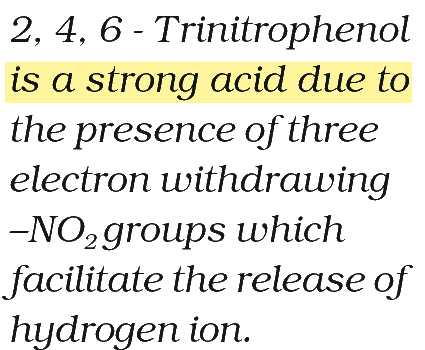
Picric acid is 2,4,6-trinitrophenol: three –\( \ce{NO2} \) groups at the two ortho and the para positions spread the negative charge very widely. This makes it a strong acid.
So the most acidic compound is picric acid.
Why the other options are incorrect
Option (1) Catechol — Incorrect. Its extra –OH donates electrons, so it is a weak acid like phenol.
Option (2) Resorcinol — Incorrect. The same reason; an electron donating –OH, no electron withdrawing group.
Option (3) Hydroquinone — Incorrect. The para –OH donates electrons most directly to the ring, so it is also a weak acid.
NCERT (2026-27 edition):
Acidity of Phenols – …