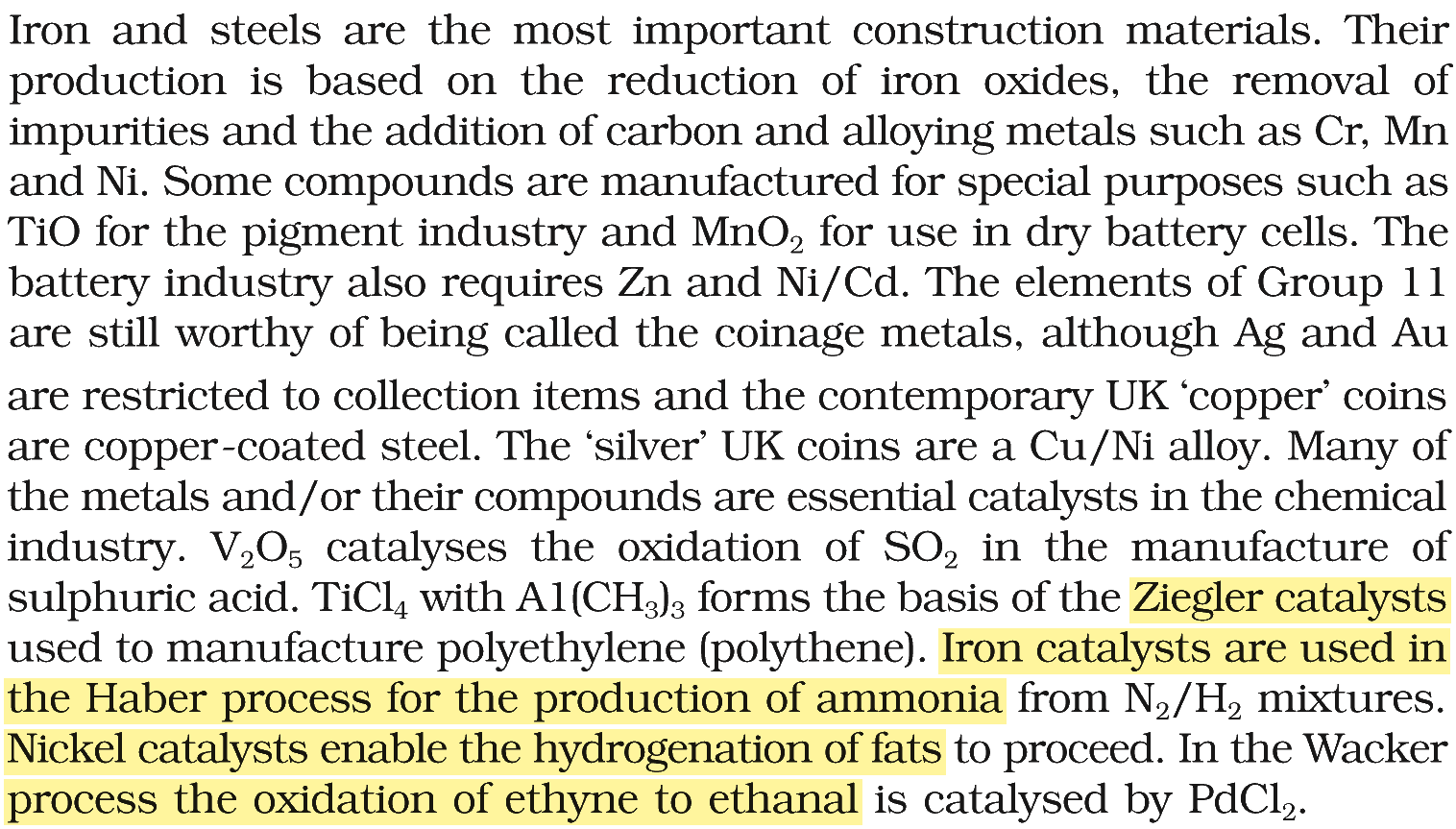
Match List-I with List-II
| List-I | List-II |
| Catalysts/ Process | Applications |
| (A) Iron catalyst | (I) Ethyne to ethanal |
| (B) Ziegler catalyst | (II) Production of ammonia |
| (C) Nickel catalysts | (III) Manufacturing of polythene |
| (D) Wacker process | (IV) Hydrogenation of fats |
Choose the correct answer from the options given below:
Answer & explanation
Correct answer: option 3
The correct answer is Option (3) → (A) - (II), (B) - (III), (C) - (IV), (D) - (I)
(A) Iron catalyst — This matches (II) Production of ammonia. In the Haber process, finely divided iron (with molybdenum as a promoter) speeds up the combination of nitrogen and hydrogen.
\( \displaystyle \ce{N2 + 3H2 <=> 2NH3} \)
(B) Ziegler catalyst — This matches (III) Manufacturing of polythene. The Ziegler-Natta catalyst, \( \ce{TiCl4} \) with \( \ce{Al(C2H5)3} \), polymerises ethene to high density polythene.
\( \displaystyle n\,\ce{CH2=CH2} \xrightarrow{\ce{TiCl4}\text{ + }\ce{Al(C2H5)3}} \left(\ce{-CH2-CH2-}\right)_{n} \)
(C) Nickel catalysts — This matches (IV) Hydrogenation of fats. Finely divided nickel adds hydrogen to the C=C bonds of vegetable oils and turns them into solid fats such as vanaspati ghee.
\( \displaystyle \ce{-CH=CH- + H2} \xrightarrow{\ce{Ni}\text{, heat}} \ce{-CH2-CH2-} \)
(D) Wacker process — This matches (I) Ethyne to ethanal. The Wacker process uses \( \ce{PdCl2} \) (with \( \ce{CuCl2} \)) to oxidise ethene to ethanal:
\( \displaystyle \ce{CH2=CH2 + PdCl2 + H2O -> CH3CHO + Pd + 2HCl} \)
Shortcut: The pair (D)–(I) appears only in Option (3).
Note: Item I says “Ethyne to ethanal”. This wording is often quoted in textbooks, but the Wacker process actually oxidises ethene to ethanal.
NCERT (2026-27 edition):
Some Applications of d- and f-Block Elements