Which of the following ketones does not give haloform reaction?
Answer & explanation
Correct answer: option 2
The correct answer is Option (2) → 3-Pentanone
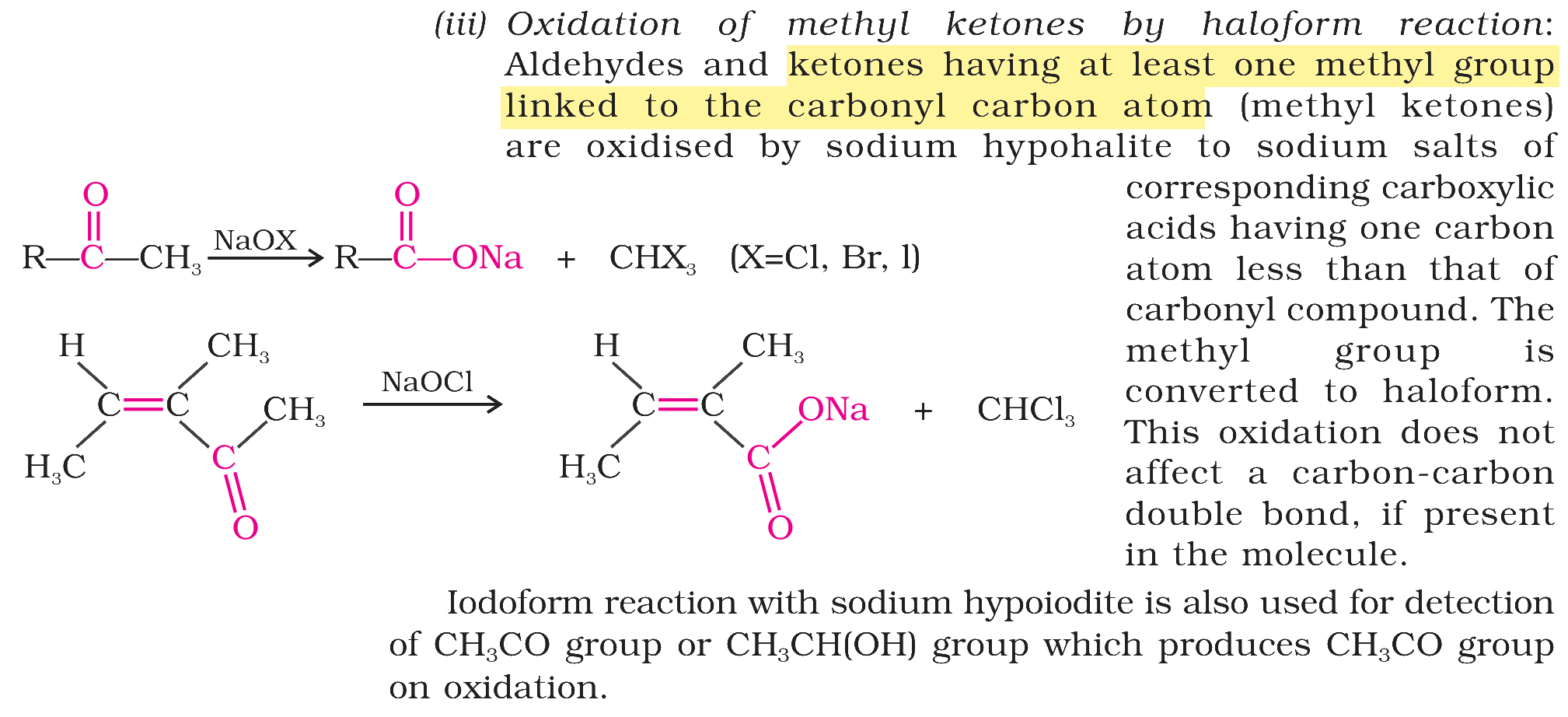
The haloform reaction is given by compounds having a methyl group attached to a carbonyl carbon, \( \ce{CH3CO} \)– (methyl ketones and acetaldehyde). The three hydrogens of this methyl group are replaced by halogen, and the \( \ce{CX3} \) group then splits off as the haloform:
\( \displaystyle \ce{R-CO-CH3 + 3NaOX -> R-CO-CX3 + 3NaOH} \)
\( \displaystyle \ce{R-CO-CX3 + NaOH -> R-COONa + CHX3} \)
Option (1) 2-Butanone — Gives the haloform reaction. \( \ce{CH3-CO-CH2CH3} \) is a methyl ketone.
Option (2) 3-Pentanone — Does not give the haloform reaction. \( \ce{CH3CH2-CO-CH2CH3} \) has an ethyl group on each side of the carbonyl carbon; there is no \( \ce{CH3CO} \)– unit.
Option (3) 2-Hexanone — Gives the haloform reaction. \( \ce{CH3-CO-(CH2)3CH3} \) is a methyl ketone.
Option (4) Acetone — Gives the haloform reaction. \( \ce{CH3-CO-CH3} \) has two methyl groups on the carbonyl carbon.
NCERT (2026-27 edition):
Oxidation of Methyl Ketones by Haloform Reaction