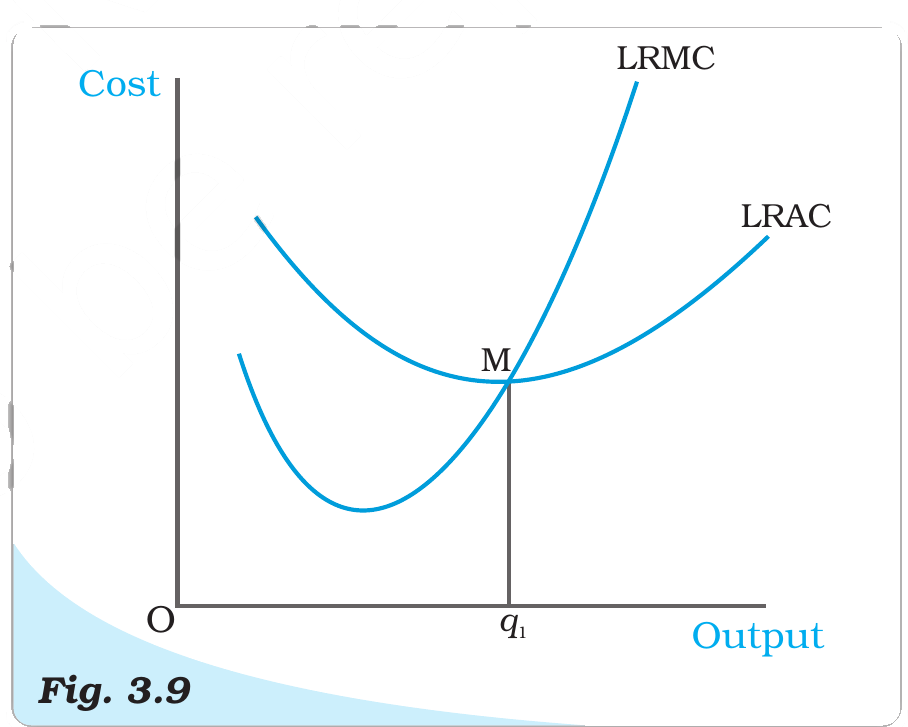
Which one of the following conditions is incorrect?
(Where, SMC - Short term Marginal Cost, AVC - Average Variable cost, SAC - Short run average cost, LRMC - Long run marginal cost, LRAC - Long run average cost.)
Answer & explanation
Correct answer: option 3
The correct answer is Option (3) → LRMC curve cuts the LRAC curve from above at the minimum point of LRAC
A marginal cost is the cost of producing one more unit; an average cost is the cost per unit of all the units together. The marginal pulls the average towards itself, as a new student’s marks pull a class average:
While the marginal is below the average, it drags the average down, so the average is falling.
While the marginal is above the average, it pulls the average up, so the average is rising.
Where the two are equal, the average neither falls nor rises: it is at its minimum.
So a U-shaped marginal cost curve meets its average cost curve coming up from below, at the lowest point of the average. The rule holds in the short run for SMC with AVC and with SAC, and in the long run for LRMC with LRAC.
Option (1) SMC curve cuts the AVC curve from below at the minimum point of AVC — A correct condition (Incorrect). While AVC falls, SMC lies below it; SMC rises through AVC at its lowest point.
Option (2) SMC curve cuts the SAC curve from below at the minimum point of SAC — A correct condition (Incorrect). The same rule applies to SAC, whose minimum lies to the right of the minimum of AVC.
Option (3) LRMC curve cuts the LRAC curve from above at the minimum point of LRAC — The incorrect condition (Correct). While LRAC is falling, LRMC must be below it, so LRMC reaches the minimum of LRAC from below, not from above. A curve cutting from above would be the pattern of the marginal product curve, which cuts the average product curve from above at the maximum of average product.
Option (4) LRMC curve cuts the LRAC curve from below at the minimum point of LRAC — A correct condition (Incorrect). This is the correct form of the statement in Option (3).
NCERT (2025-26): “Shapes of the Short Run Cost Curves … As long as AVC is falling, SMC must be less than the AVC. As AVC rises, SMC must be greater than the AVC. So the SMC curve cuts the AVC curve from below at the minimum point of AVC.… …Similar to the case of AVC and SMC, as long as SAC is falling, SMC is less than the SAC. When SAC is rising, SMC is greater than the SAC. SMC curve cuts the SAC curve from below at the minimum point of SAC.… …Let us check how the LRMC curve looks like. For the first unit of output, both LRMC and LRAC are the same. Then, as output increases, LRAC initially falls, and then, after a certain point, it rises. As long as average cost is falling, marginal cost must be less than the average cost. When the average cost is rising, marginal cost must be greater than the average cost. LRMC curve is therefore a ‘U’-shaped curve. It cuts the LRAC curve from below at the minimum point of the LRAC. Figure 3.9 shows the shapes of the long run marginal cost and the long run average cost curves for a typical firm.…”
|