Identify which of the given haloalkanes does not undergo elimination reaction?
Answer & explanation
Correct answer: option 4
The correct answer is Option (4) → 1-Chloro-2,2,2-triphenylethane
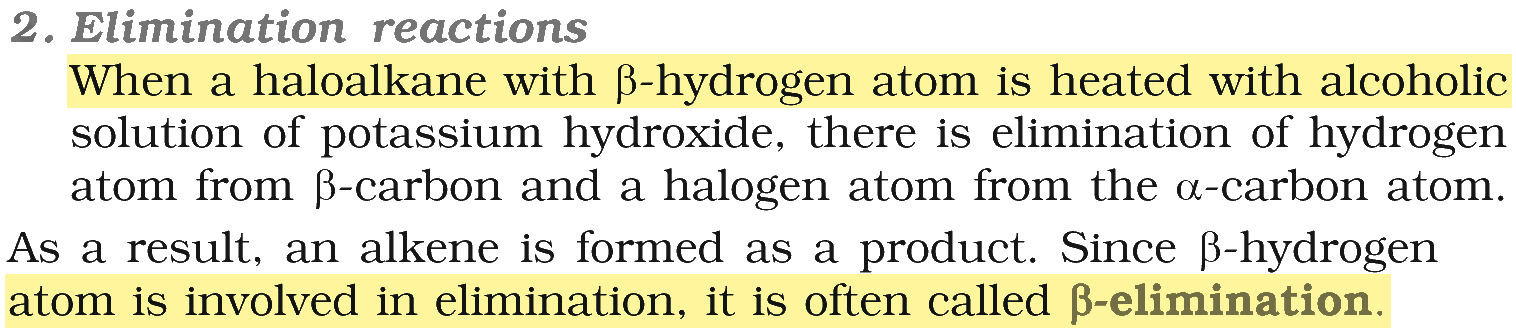
On heating with alcoholic KOH, a haloalkane loses a hydrogen from the β-carbon and the halogen from the α-carbon to form an alkene; this needs at least one β-hydrogen:
\( \displaystyle \ce{R-CH2-CH2-X + KOH} \xrightarrow[\Delta]{\text{ethanol}} \ce{R-CH=CH2 + KX + H2O} \)
Option (1) Chloroethane — Undergoes elimination. \( \ce{CH3-CH2Cl} \) has three β-hydrogens and gives ethene.
Option (2) 1-Chloro-2-phenylethane — Undergoes elimination. \( \ce{C6H5CH2-CH2Cl} \) has two β-hydrogens and gives styrene (\( \ce{C6H5CH=CH2} \)).
Option (3) 1-Chloro-2,2-diphenylethane — Undergoes elimination. \( \ce{(C6H5)2CH-CH2Cl} \) still has one β-hydrogen and gives 1,1-diphenylethene.
Option (4) 1-Chloro-2,2,2-triphenylethane — Does not undergo elimination. In \( \ce{(C6H5)3C-CH2Cl} \) the β-carbon carries three phenyl groups and no hydrogen.
NCERT (2026-27 edition):
Elimination Reactions