
Read the given passage and answer the following questions:
In nature, we rarely find isolated, single individuals of any species; majority of them live in groups in a well defined geographical area, share or compete for similar resources, potentially interbreed and thus constitute a population. A population has certain attributes whereas, an individual organism does not. An individual may have births and deaths, but a population has birth rates and death rates. In a population these rates refer to per capita births and deaths. The rates, hence, expressed are change in numbers (increase or decrease) with respect to members of the population. Here is an example. If in a pond there were 20 lotus plants last year and through reproduction 8 new plants are added, taking the current population to 28, we calculate the birth rate as 8/20 = 0.4 offspring per lotus per year. If 4 individuals in a laboratory population of 40 fruitflies died during a specified time interval, say a week, the death rate in the population during that period is 4/40 = 0.1 individuals per fruitfly per week. Another attribute characteristic of a population is sex ratio. An individual is either a male or a female but a population has a sex ratio (e.g., 60 per cent of the population are females and 40 per cent males). A population at any given time is composed of individuals of different ages. If the age distribution (per cent individuals of a given age or age group) is plotted for the population, the resulting structure is called an age pyramid. For human population, the age pyramids generally show age distribution of males and females in a diagram. The shape of the pyramids reflects the growth status of the population - (a) whether it is growing, (b) stable or (c) declining.
A population in a habitat has a density of 500 at time t. During the next year, 120 individuals are born, 30 individuals come in from elsewhere, 80 individuals die and 20 individuals leave the habitat. What will be the population density at time t + 1?
Answer & explanation
Correct answer: option 3
The correct answer is Option (3) → 550
Births (B) and immigrants (I) add to the population; deaths (D) and emigrants (E) take away from it. The density at time t + 1 is:
Nt+1 = Nt + [(B + I) – (D + E)]
Here Nt = 500, B = 120, I = 30, D = 80 and E = 20.
Nt+1 = 500 + [(120 + 30) – (80 + 20)] = 500 + (150 – 100) = 550
The other values come from slips. 450 takes away the gain instead of adding it, 540 leaves out immigration and emigration (500 + 120 – 80), and 590 adds the 20 emigrants instead of subtracting them.
NCERT Extract:
Population Growth – “… So, if N is the population density at time t, then its density at time t +1 is Nt+1 = Nt + [(B + I) – (D + E)] You can see from the above equation (Fig. 11.2) that population density will increase if the number of births plus the number of immigrants (B + I) is more than the number of deaths plus the number of emigrants (D + E).”
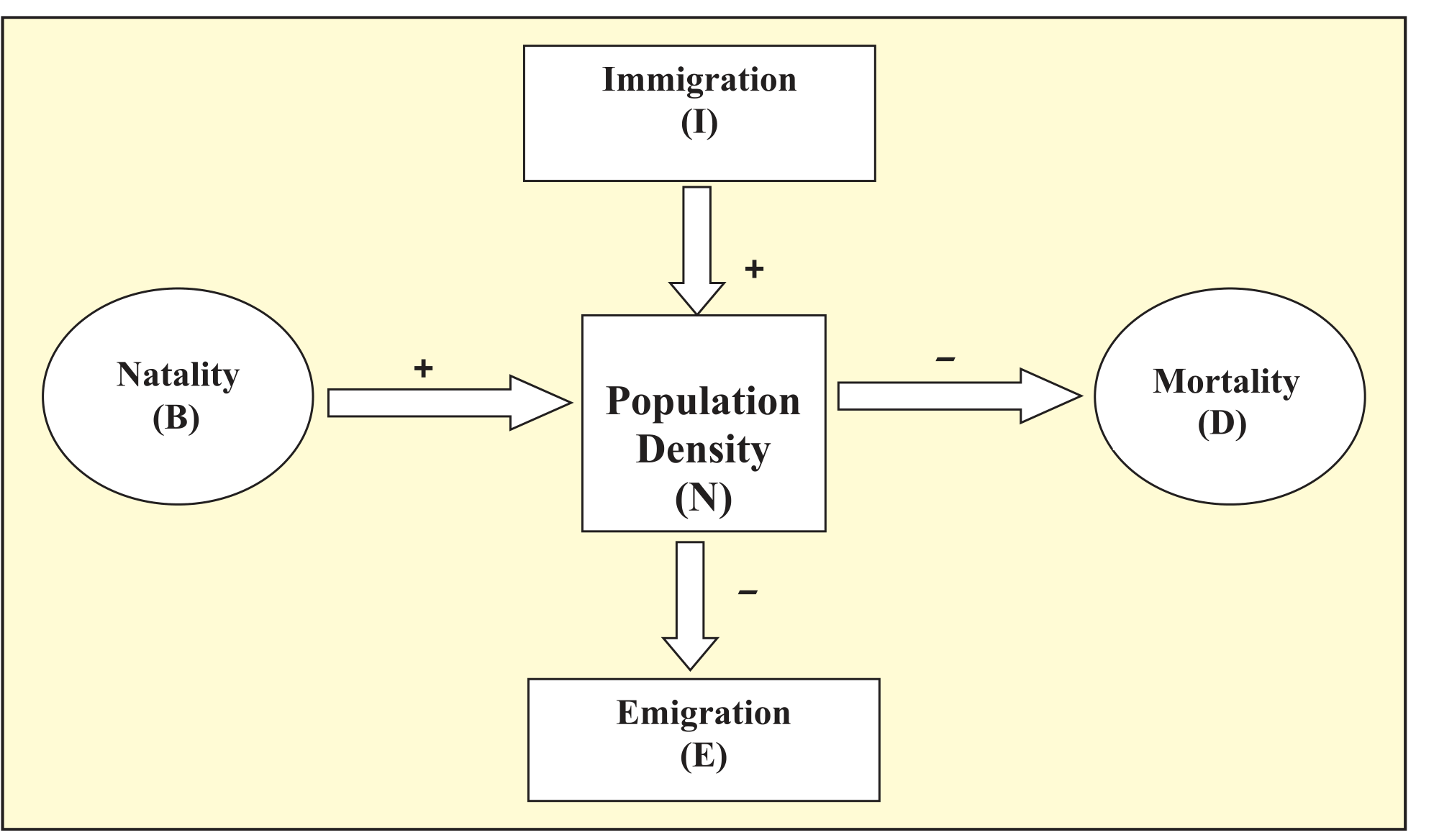
Figure 11.2