
A manufacturer makes two products, A and B. Product A sells at ₹200 each and takes $\frac{1}{2}$ hour to make. Product B sells at ₹300 each and takes 1 hour to make. There is a permanent order for 14 units of product A and 16 units of product B. A working week consists of 40 hours of production and the weekly turnover must not be less than ₹10000. If the profit on each of product A is ₹20 and on product B is ₹30, then how many of each should be produced so that the profit is maximum? Also find the maximum profit.
Answer & explanation
Correct answer: option 2
The correct answer is Option (2) → ₹1440
Let x and y be the number of units of products A and B respectively manufactured (and sold), then total profit $P = 20x + 30y$ (in ₹).
Hence, the problem can be formulated as an L.P.P. as follows:
Maximize $P = 20x + 30y$ subject to the constraints
$200x + 300y ≥ 10000$ i.e. $2x + 3y ≥ 100$ (turnover constraint)
$\frac{1}{2}x + 1.y ≤ 40$ i.e. $x + 2y ≤ 80$
$x ≥ 14, y ≥ 16, x ≥ 0, y ≥ 0$. (time constraint)
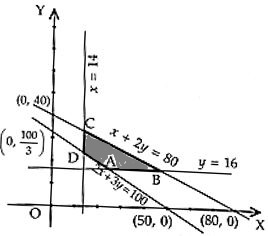
We draw the straight lines $2x + 3y = 100, x + 2y = 80, x = 14$ and $y = 16$ and shade the region satisfied by the above inequalities.
The shaded portion shows the feasible region ABCD, which is bounded. The corner points of the feasible region ABCD are A(26, 16), B(48, 16), C(14, 33) and D(14, 24).
The optimal solution occurs at one of the corner points.
At $A, P = 20 × 26 + 30 × 16 = 1000$.
At $B, P = 20 × 48 + 30 × 16 = 1440$.
At $C, P = 20 × 14 + 30 × 33 = 1270$.
At $D, P = 20 × 14 + 30 × 24 = 1000$.
Hence, the manufacturer should produce 48 units of product A and 16 units of product B. Maximum profit is ₹1440.