Read the given case-study carefully and answer the question that follow.
According to Lazarus and his colleagues, people have a tendency to appraise any situation as positive, negative or neutral. When Vikram lost his job as event manager, he perceived the situation as negative but he didn't lose heart and decided to start a food joint as he was handling similar projects in the past. Whereas Vikas who also lost his job as a marketing manager, started feeling helpless and hopeless and consumed alcohol regularly. He started coming up with excuses for not doing anything. He could not even think of starting his own venture as he had no money to invest. He would often become very angry or would start crying bitterly.
In the above case study, Vikram was able to take a decision of starting his own venture on the basis of :
Answer & explanation
Correct answer: option 3
The correct answer is Option (3) → Past experience
How a stressful event is appraised depends on several factors. The case says Vikram started a food joint ‘as he was handling similar projects in the past’.
Option (1) Intensity of problem — Incorrect. Intensity is one of the dimensions on which stresses differ (low intensity vs. high intensity). It describes the stress itself, not the basis on which Vikram decided.
Option (2) Complexity of problem — Incorrect. Complexity too is a dimension of the stress (less complex vs. more complex). Nothing in the case turns on how complex the job loss was.
Option (3) Past experience — Correct. One factor in appraisal is the past experience of dealing with such a stressful condition. If one has handled similar situations very successfully in the past, they are less threatening. Vikram’s earlier projects let him see the loss of his job as a problem he could manage.
Option (4) Controllability — Incorrect. Controllability is another factor in appraisal: whether one believes one has mastery or control over the situation. The case does not speak of Vikram’s sense of control; it names his earlier experience as the reason.
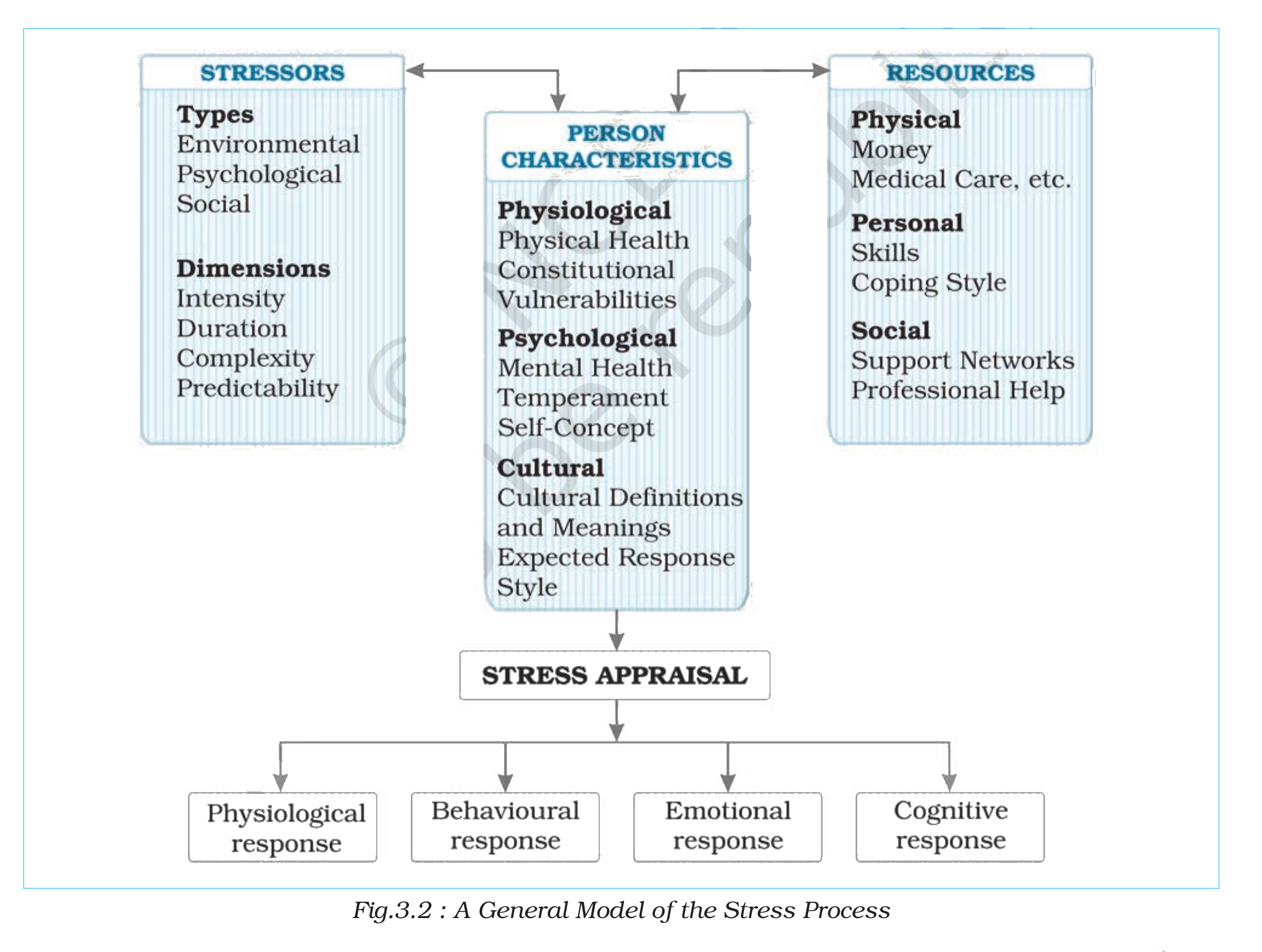
NCERT (2025-26): “Nature of Stress … These appraisals are very subjective and will depend on many factors. One factor is the past experience of dealing with such a stressful condition. If one has handled similar situations very successfully in the past, they would be less threatening for her/him. Another factor is whether the stressful event is perceived as controllable, i.e. whether one has mastery or control over a situation. A person who believes that s/he can control the onset of a negative situation, or its adverse consequences, will experience less amount of stress than those who have no such sense of personal control.…” “Nature of Stress … As indicated in Figure 3.2, the stresses which people experience also vary in terms of intensity (low intensity vs. high intensity), duration (short-term vs. long-term), complexity ( less complex vs. more complex) and predictability (unexpected vs. predictable). The outcome of stress depends on the position of a particular stressful experience along these dimensions. Usually more intense, prolonged or chronic, complex and unanticipated stresses have more negative consequences than have less intense, short-term, less complex and expected stresses.…”
|