
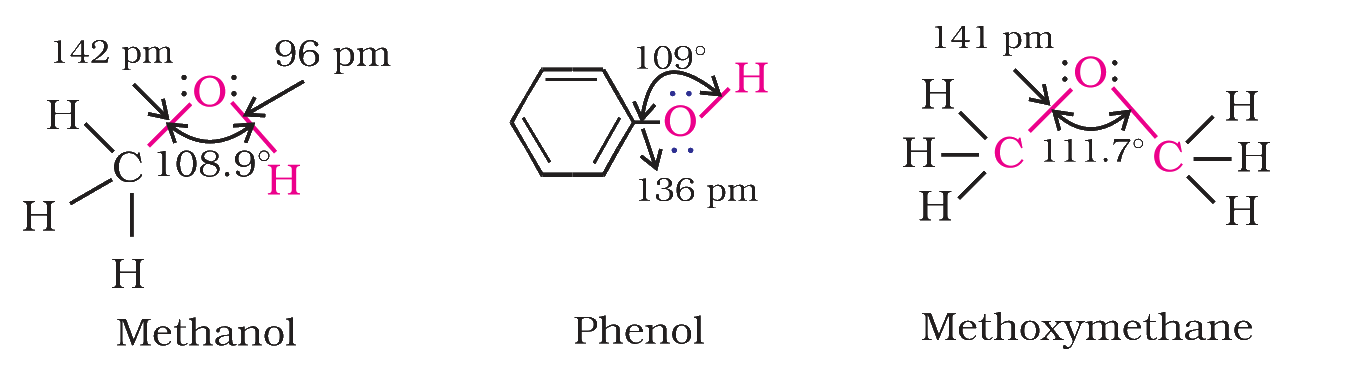
The figure shows the structures of methanol, phenol and methoxymethane.
In which compound shown is the bond angle at oxygen greater than the tetrahedral angle (109°28′), and what is the reason?
Answer & explanation
Correct answer: option 3
The correct answer is Option (3) → Methoxymethane; repulsion between the two bulky groups attached to oxygen
The oxygen in each compound has two bond pairs and two lone pairs, so the angle at oxygen is close to the tetrahedral angle, 109°28′.
The figure gives 108.9° for the C–O–H angle of methanol, 109° for that of phenol and 111.7° for the C–O–C angle of methoxymethane; only 111.7° is greater than 109°28′.
In the ether, oxygen carries two –CH3 groups, and the repulsion between these two bulky groups opens the angle.
Why the other options are incorrect
Option (1) Methanol; repulsion between the unshared electron pairs of oxygen — Incorrect. The C–O–H angle of methanol is 108.9°, slightly less than the tetrahedral angle, not greater.
Option (2) Phenol; repulsion between the unshared electron pairs of oxygen — Incorrect. The C–O–H angle of phenol is 109°, also slightly less than 109°28′.
Option (4) Methoxymethane; repulsion between the unshared electron pairs of oxygen — Incorrect. The compound is right, but repulsion between the unshared pairs makes the angle smaller than tetrahedral, as in alcohols; it cannot explain a larger angle.
NCERT (2026-27 edition):
7.3 Structures of Functional Groups – “The bond angle in alcohols is slightly less than the tetrahedral angle (109°-28′). It is due to the repulsion between the unshared electron pairs of oxygen.”
“In ethers, the four electron pairs, i.e., the two bond pairs and two lone pairs of electrons on oxygen are arranged approximately in a tetrahedral arrangement. The bond angle is slightly greater than the tetrahedral angle due to the repulsive interaction between the two bulky (–R) groups.”
Fig. 7.1: Structures of methanol, phenol and methoxymethane