CUETMOCK
  • Pricing
  • Mentors
Log inStart freeStart free mocks→

First test, then trust

Try a free CUET mock test.

Join 5,00,000+ students who rehearsed exam day on the exact NTA screen before sitting CUET. On the web and on Android.

Start free mocks →Get the Android app
CUETMOCK

India's #1 CUET Mock Test Platform. Original NCERT-based questions on the exact NTA exam screen — trusted by 5,00,000+ students since CUET 2022.

Get it onGoogle PlayScan to download the CUETMOCK app

Mock tests

  • CUET mock test series
  • Browse all papers
  • Commerce mocks
  • Humanities (Arts) mocks
  • Science mocks
  • Languages & GAT mocks
  • Free practice questions
  • Pricing

Resources

  • CUET exam guide
  • CUET syllabus
  • Universities accepting CUET
  • Expert blogs
  • News & notifications
  • Webinars & counselling
  • CUET score calculator
  • How we estimate your rank
  • FAQs

Company

  • About us
  • Our leadership & team
  • Our toppers
  • Mentors
  • For schools
  • Contact us
  • Terms
  • Privacy
  • Refund policy

Talk to us

+91 7696 6630 56info@cuetmock.comWhatsApp us

Our other platforms

  • JEE Mock — For IIT-JEE aspirants
  • NEET Mock — For NEET aspirants

Newsletter

Exam updates, study material and offers — no spam.

© 2026 NYC Ventures Pvt. Ltd.

701-702, Royal Business Park, Zirakpur, Punjab - 140603

  • Terms of use
  • Privacy policy
  • Refund policy
  • Contact us

iCUETMOCK is an independent preparation platform, not affiliated with the National Testing Agency (NTA). Always check exam details on the official NTA website.

  • Home
  • Mock tests
  • CUET guide
  • Pricing
  • Log in
Home/Practice questions/Sociology
SociologyIndian Society: Challenges of Cultural Diversity

Arrange the following statements in correct sequence of events: (A) E…

Arrange the following statements in correct sequence of events:

(A) Effort to reorganise into ethno-linguistic states

(B) Indian State continued with British-Indian arrangement of presidencies

(C) Vigorous movements among Maratha and Kannada Speakers in Bombay and Madras presidencies

(D) Pakistan was divided between Urdu and Punjabi speakers in the West and Bengali speakers in the East

(E) Formation of SRC for final approval on linguistic states

Choose the correct answer from the options given below:

Answer & explanation+

Correct answer: option 2

The correct answer is Option (2) → (B), (A), (C), (E), (D)

Note: The given answer is as per the official NTA Answer Key. However, there seems to be an ambiguity in the question. The key follows the order in which the book presents the events, with the reorganisation into ethno-linguistic states (A) placed straight after the presidencies (B); going strictly by cause and effect, the vigorous movements (C) came first and the effort to reorganise (A) followed in response to them, which gives (B), (C), (A), (E), (D), that is Option (3), as explained below.

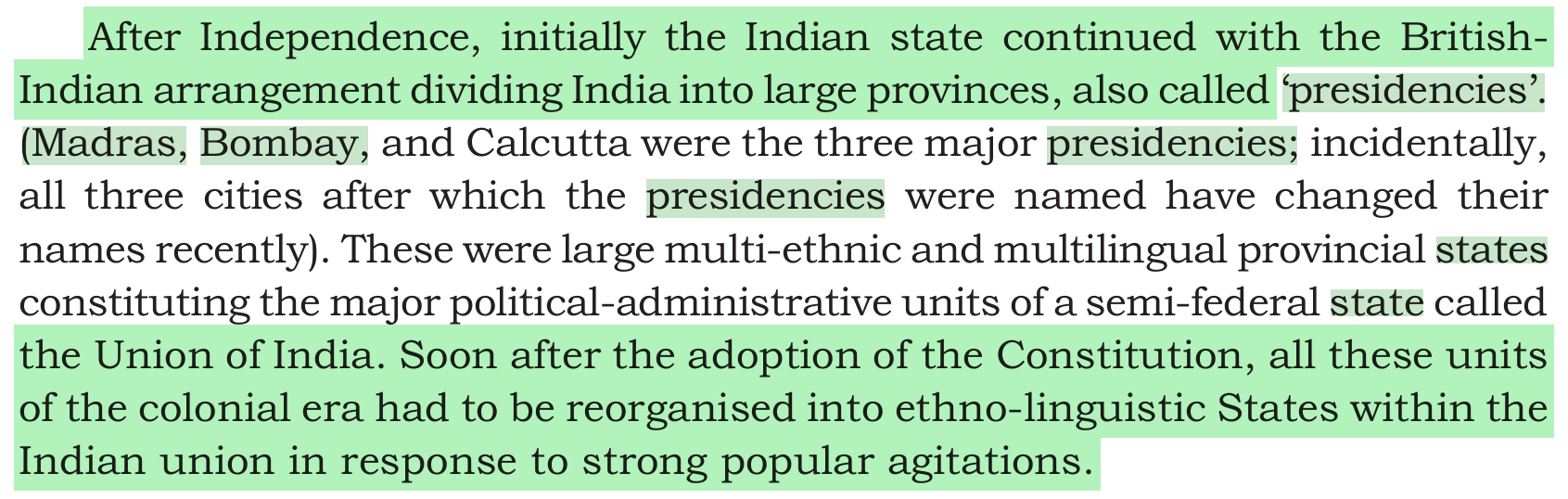
(B) Indian State continued with British-Indian arrangement of presidencies — After Independence the Indian state first continued with the British-Indian arrangement of large provinces called presidencies, such as Madras, Bombay and Calcutta, which were multi-ethnic and multilingual.

(A) Effort to reorganise into ethno-linguistic states — Soon after the adoption of the Constitution, these colonial units had to be reorganised into ethno-linguistic States in response to strong popular agitations. In NTA’s order this effort is placed here, second; read as a response to the agitations, it would come after (C).

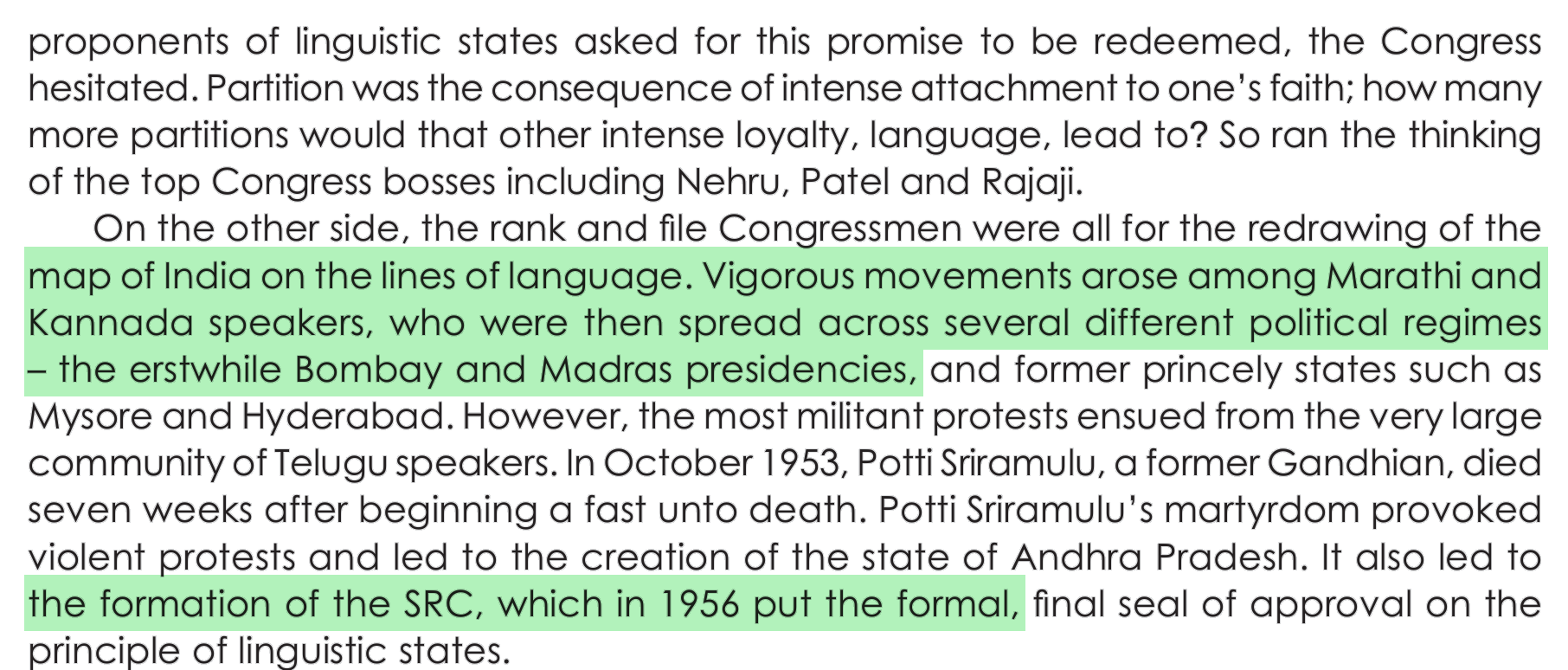
(C) Vigorous movements among Maratha and Kannada Speakers in Bombay and Madras presidencies — When the Congress hesitated to redeem its promise of linguistic provinces after 1947, vigorous movements arose among Marathi and Kannada speakers, who were spread across the Bombay and Madras presidencies and princely states such as Mysore and Hyderabad.

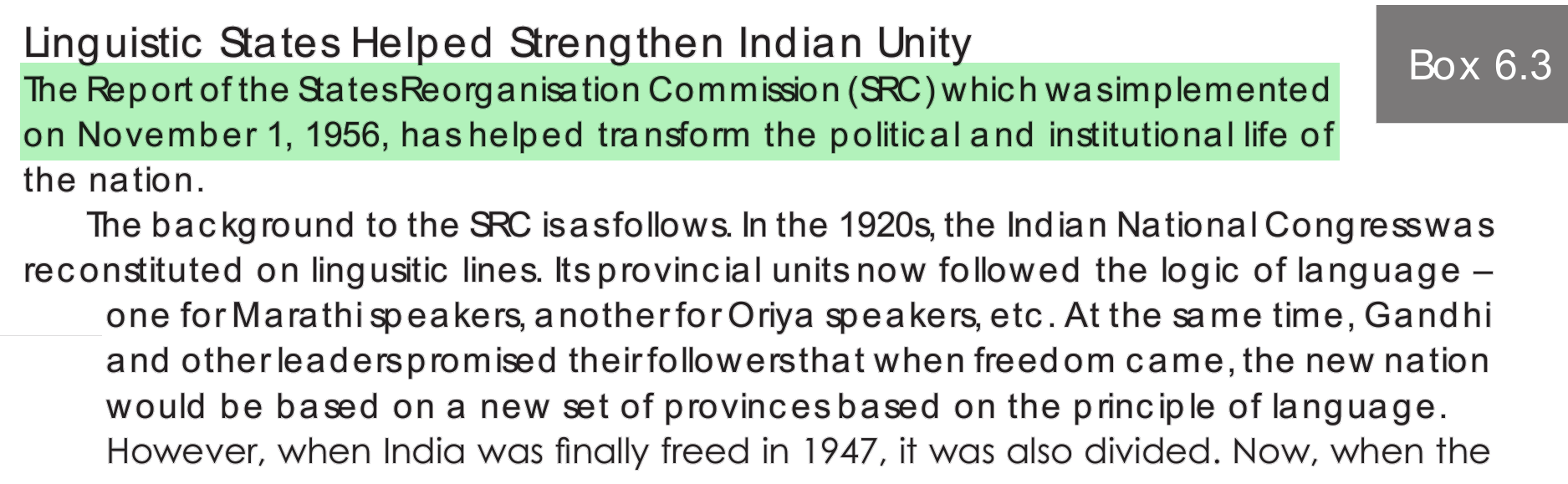
(E) Formation of SRC for final approval on linguistic states — The Telugu protests after Potti Sriramulu’s death in 1953 led to Andhra Pradesh and to the States Reorganisation Commission, which in 1956 put the formal, final seal of approval on the principle of linguistic states.

(D) Pakistan was divided between Urdu and Punjabi speakers in the West and Bengali speakers in the East — This came last: Pakistan was divided in 1971 because the Punjabi and Urdu speakers of its western wing would not respect the sentiments of the Bengalis in the east.


NCERT: Indian Society — Chapter 6: The Challenges of Cultural Diversity (2025-26)

NCERT extract

NCERT extract

NCERT extract

NCERT extract

Advertisement

Practise more on Indian Society: Challenges of Cultural Diversity

Chapter-wise mocks on the real NTA exam screen, with solutions and your rank. Your first mocks are free.

Start free mocks →

Advertisement

Next questions

  1. What is Sultan Adil Shah II depicted doing in the painting?Fine Arts · The Deccani Schools of Painting
  2. For an astronomical telescope having objective lens of focal length 10 m and eyepiece lens of focal length 10 cm, telescope's tube length a…Physics · Ray Optics
  3. According to the Malthusian theory of population growth find the correct options. (A) Population rises in geometric progression (B) Agricul…Sociology · Indian Society: Demographic Structure of Indian Society
  4. Choose the word that can substitute the given group of words. Containing more words than necessaryEnglish · One Word
  5. A man buys 20 Pens and 16 Pencils in 360. He sells each pen at 25% profit and each pencil at 40% profit. He gets 120 profit in whole, find…General Aptitude Test · Numerical Ability
  6. Who coined the term 'Status Symbol'?Sociology · Indian Society: Market as a social Institution
  7. The half life for radioactive decay of C-14 is 5730 years. A sample of tree had only 80% of C-14 left. Estimate the age of tree. (log 5=0.6…Chemistry · Physical: Chemical Kinetics
  8. Which of the following can be a probability distribution function for a random variable X? A. X012 P(x)0.40.40.2 B. X1234 P(x)0.10.40.3−0.2…Applied Maths. Section B2 · Probability Distributions
  9. The common region determined by all constraints of a Linear programming problem is called:Applied Maths. Section B2 · Linear Programming
  10. Which of the following best illustrates India's tradition of religious syncretism?Sociology · Indian Society: Challenges of Cultural Diversity