Match List I with List II:
| List I | List II |
 |
 |
 |
 |
 |
 |
 |
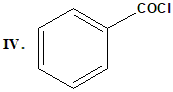 |
Choose the correct answer from the options given below:
Answer & explanation
Correct answer: option 2
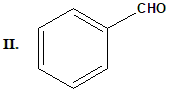
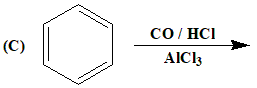
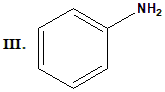
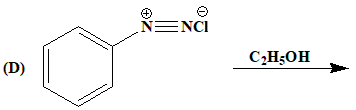
The correct answer is option 2. A-III, B-IV, C-II, D-I.
| List I | List II |
|
|
|
|
|
|
|
|
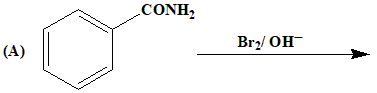
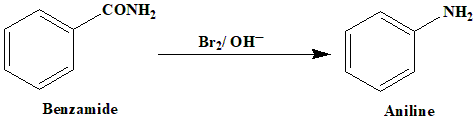
A. Hoffmann bromamide reaction generally includes the use of an alkali as a strong base to attack the amide, leading to the deprotonation and the subsequent generation of an anion. This reaction is used for the conversion of a primary amide to a primary amine with one less carbon atom. This is accomplished by heating the primary amide with a mixture of a halogen (chlorine or bromine), a strong base, and water. The reaction can be illustrated as follows:
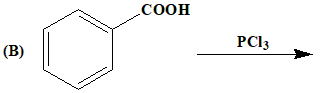
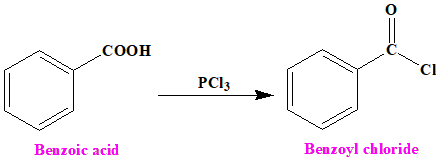
B. Benzoic acid reacts with \(PCl_3\) to give Benzoyl chloride.
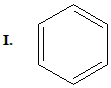
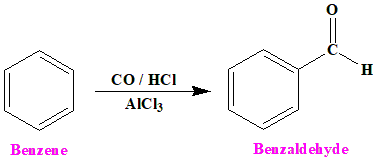
C. Benzene undergoes electrophilic substitution reaction when treated with carbon monoxide and hydrochloric acid in presence of anhydrous aluminum chloride to give benzaldehyde. The hydrogen atom in benzene is substituted by the aldehyde group. This reaction is known as the Gattermann Koch reaction.
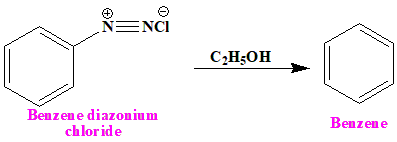
D. Ethanol is treated with benzene diazonium chloride it forms benzene and acetaldehyde as major products and hydrochloric acid and nitrogen gas is released. The chemical reaction can be represented as: