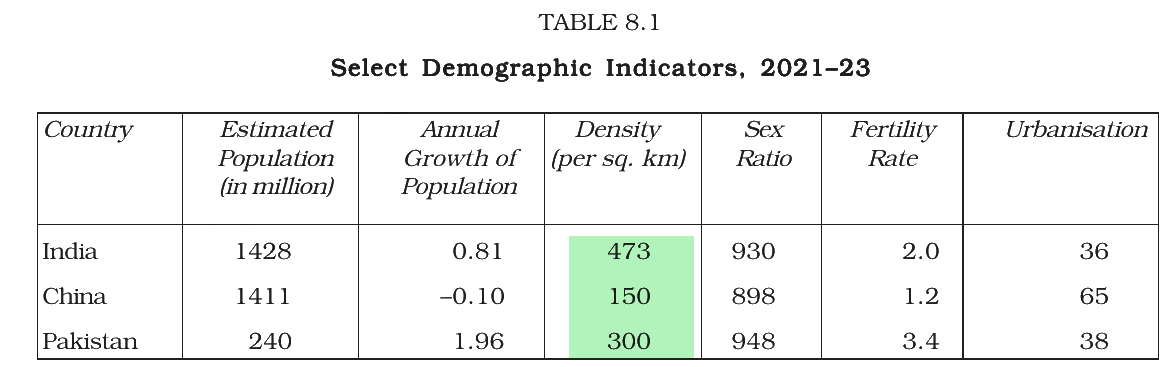
If we look at the global population, out of every six persons living in this world, one is an Indian and another a Chinese. Though China is the largest nation and geographically occupies the largest area among the three nations, its density is the lowest. The population growth is the highest in Pakistan, followed by India and China. Scholars point out the one child norm introduced in China in the late 1970s as the major reason for low population growth. They also state that this measure led to a decline in the sex ratio, the proportion of females per 1000 males. However, one can notice that the sex ratio is low and biased against females in all three countries. Scholars cite son preference prevailing in all these countries as the reason. In recent times, all three countries are adopting various measures to improve the situation. One child norm and the resultant arrest in the growth of population also have other implications. For instance, after a few decades, in China, there will be more elderly people in proportion to young people. This led China to allow couples to have two children.
One of the much-talked issues around the world about China is its growth of Gross Domestic Product. When many developed countries were finding it difficult to maintain a growth rate of even 5 per cent, China was able to maintain near double-digit growth during 1980s. In the industrial sector, China has maintained a near double-digit growth rate in 1980s but began showing decline in recent years, whereas, for India and Pakistan growth rate has declined. In case of service sector, China was able to maintain its rate of growth during 1980–1990, while there was a positive and increasing growth of India’s service sector output. Thus, China’s growth is contributed by the manufacturing and service sectors and India’s growth by the service sector.
The passage says that China’s density of population is the lowest of the three countries. Consider the following statements on density of population (2021-23):
(A) India’s density of population is higher than Pakistan’s.
(B) Pakistan’s density of population is higher than India’s.
(C) India’s density of population is more than three times China’s.
Choose the correct answer from the options given below:
Answer & explanation
Correct answer: option 1
The correct answer is Option (1) → (A) and (C) only
The density figures (people per sq. km, 2021-23) are India 473, Pakistan 300 and China 150.
(A) India’s density of population is higher than Pakistan’s. — Correct. 473 is more than 300.
(B) Pakistan’s density of population is higher than India’s. — Incorrect. Pakistan’s 300 is below India’s 473.
(C) India’s density of population is more than three times China’s. — Correct. Three times China’s density is 3 × 150 = 450, and India’s 473 is more than that.
NCERT (2026-27): “… Though China is the largest nation and geographically occupies the largest area among the three nations, its density is the lowest. …” |