Rate of reaction
Consider a general reaction: aA + bB → cC + dD
where a, b, c and d are the stoichiometric coefficients of reactants and products. The rate expression for this reaction is Rate ∝ [A]x[B]y
where exponents x and y may or may not be equal to the stoichiometric coefficients (a and b) of the reactants. Above equation can also be written as Rate = k[A]x[B]y
Sum of these exponents, i.e., x + y gives the overall order of a reaction whereas x and y represent the order with respect to the reactants A and B, respectively.
\( \displaystyle -\frac{d[\mathrm{R}]}{dt}=k[\mathrm{A}]^x[\mathrm{B}]^y \)
The above equation is known as differential rate equation, where k is a proportionality constant called rate constant. The equation, which relates the rate of a reaction to concentration of reactants is called rate law or rate expression.
In the rate law expression reaction rate is given in terms of molar concentration of reactants with each term raised to some power, which may or may not be same as the stoichiometric coefficient of the reacting species in a balanced chemical equation. For example:
2NO2(g) + O2(g) → 2NO3(g)
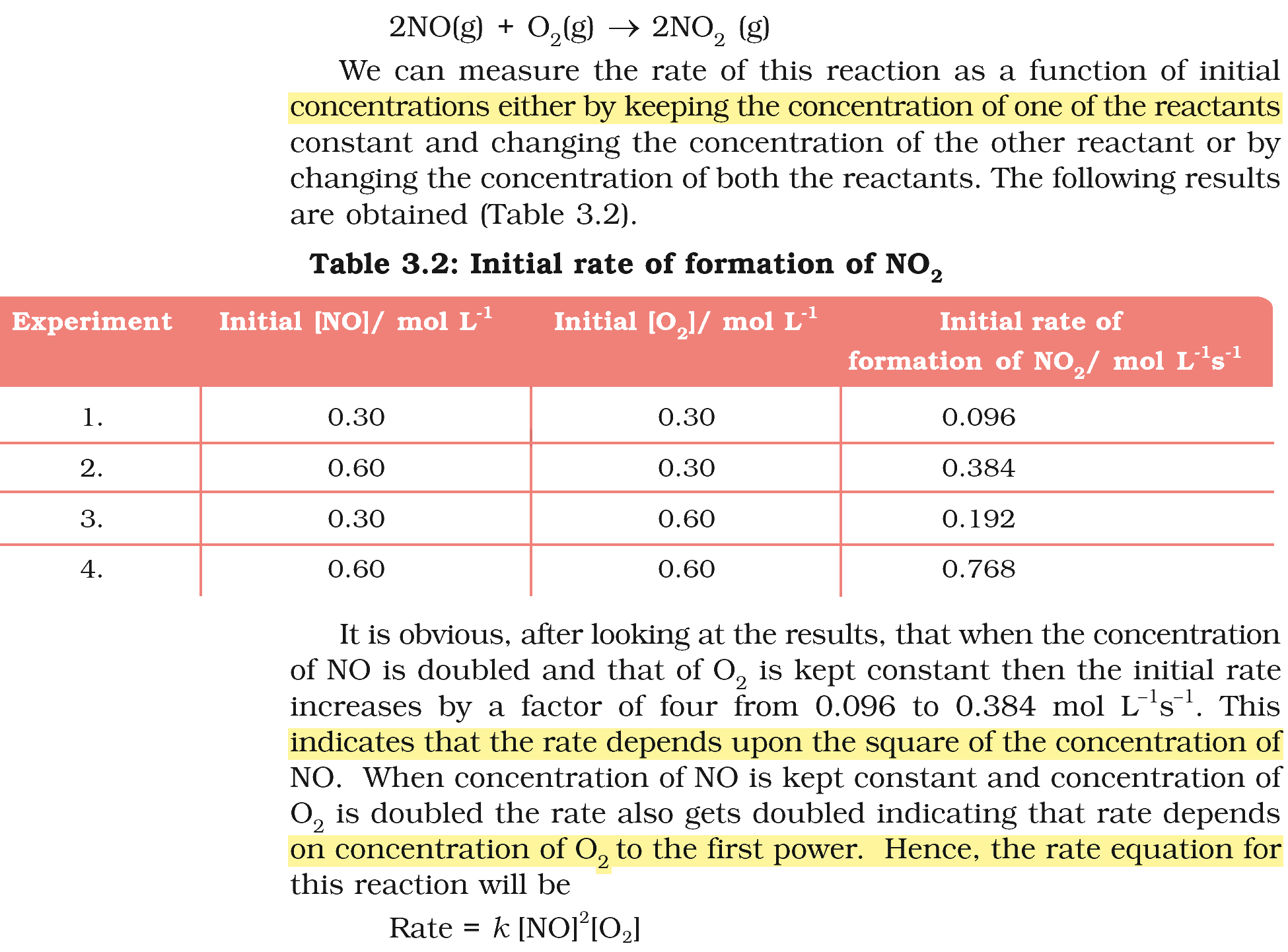
The rate of this reaction is measured as a function of initial concentrations either by keeping the concentration of one of the reactants constant and changing the concentration of the other reactant or by changing the concentration of both the reactants. The results obtained are tabulated in table below:
| Experiment | Initial [NO2]/mol L−1 | Initial [O2]/mol L−1 | Initial rate of formation of [NO3]/mol L−1s−1 |
| 1 | 0.25 | 0.25 | 0.090 |
| 2 | 0.50 | 0.25 | 0.360 |
| 3 | 0.25 | 0.50 | 0.180 |
| 4 | 0.50 | 0.50 | 0.720 |
The correct rate equation and overall order of the reactions respectively, is:
Answer & explanation
Correct answer: option 2
The correct answer is Option (2) → Rate = k[NO2]2[O2]1; Overall Order = 3
The rate law has the form Rate = k\( \ce{[NO2]} \)x\( \ce{[O2]} \)y, and the order of the reaction is the sum of the exponents, x + y. Each exponent is found by comparing two experiments in which only that concentration changes.
Order with respect to \( \ce{NO2} \) (Experiments 1 and 2, \( \ce{[O2]} \) fixed, \( \ce{[NO2]} \) doubled):
\( \displaystyle \frac{0.360}{0.090}=2^x \quad\Rightarrow\quad 4=2^x \quad\Rightarrow\quad x=2 \)
Order with respect to \( \ce{O2} \) (Experiments 1 and 3, \( \ce{[NO2]} \) fixed, \( \ce{[O2]} \) doubled):
\( \displaystyle \frac{0.180}{0.090}=2^y \quad\Rightarrow\quad 2=2^y \quad\Rightarrow\quad y=1 \)
\( \displaystyle \text{Rate}=k[\ce{NO2}]^2[\ce{O2}]^1 \quad \quad \text{Order of the reaction}=2+1=3 \)
Check with Experiment 4, where both concentrations are doubled: the rate should rise by 22 × 2 = 8, and indeed 0.090 × 8 = 0.720 mol L−1 s−1.
So the rate equation is Rate = k[NO2]2[O2] and the order of the reaction is 3.
Why the other options are incorrect
Option (1) Rate = k[NO2]2[O2]2; Overall Order = 4 — Incorrect. Doubling \( \ce{[O2]} \) would then make the rate four times faster, but Experiment 3 shows it only doubles.
Option (3) Rate = k[NO2]1[O2]2; Overall Order = 3 — Incorrect. The two orders are swapped; doubling \( \ce{[NO2]} \) would then only double the rate, but Experiment 2 shows it quadruples.
Option (4) Rate = k[NO2]1[O2]2; Overall Order = 2 — Incorrect. The orders are swapped, and the order 2 given for the reaction does not even match the exponents written (1 + 2 = 3).
Note: It seems that there is a mistake in the original NTA paper, which prints 2NO2(g) + O2(g) → 2NO3(g) when it should read 2NO(g) + O2(g) → 2NO2(g).
NCERT (2026-27 edition):
Rate Expression and Rate Constant – …