
CUETMOCK
  • Pricing
  • Mentors
Log inStart freeStart free mocks→

First test, then trust

Try a free CUET mock test.

Join 5,00,000+ students who rehearsed exam day on the exact NTA screen before sitting CUET. On the web and on Android.

Start free mocks →Get the Android app
CUETMOCK

India's #1 CUET Mock Test Platform. Original NCERT-based questions on the exact NTA exam screen — trusted by 5,00,000+ students since CUET 2022.

Get it onGoogle PlayScan to download the CUETMOCK app

Mock tests

  • CUET mock test series
  • Commerce mocks
  • Humanities (Arts) mocks
  • Science mocks
  • Languages & GAT mocks
  • Free practice questions
  • Pricing

Resources

  • CUET exam guide
  • CUET syllabus
  • Universities accepting CUET
  • Expert blogs
  • News & notifications
  • Webinars & counselling
  • CUET score calculator
  • How we estimate your rank
  • FAQs

Company

  • About us
  • Our leadership & team
  • Our toppers
  • Mentors
  • For schools
  • Contact us
  • Terms
  • Privacy
  • Refund policy

Talk to us

+91 7696 6630 56info@cuetmock.comWhatsApp us

Our other platforms

  • JEE Mock — For IIT-JEE aspirants
  • NEET Mock — For NEET aspirants

Newsletter

Exam updates, study material and offers — no spam.

© 2026 NYC Ventures Pvt. Ltd.

701-702, Royal Business Park, Zirakpur, Punjab - 140603

  • Terms of use
  • Privacy policy
  • Refund policy
  • Contact us

iCUETMOCK is an independent preparation platform, not affiliated with the National Testing Agency (NTA). Always check exam details on the official NTA website.

  • Home
  • Mock tests
  • CUET guide
  • Pricing
  • Log in
Home/Practice questions/Fine Arts
Fine ArtsThe Modern Indian Art

What is the common feature of the figures in "Children"?

Look at the image and  answer the following question:
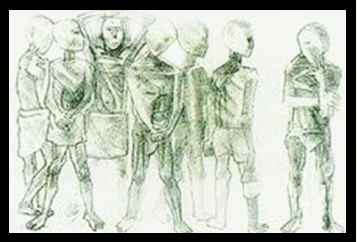
What is the common feature of the figures in "Children"?

Answer & explanation+

Correct answer: option 3

Answer: Linear with skeletal torsos and stick-like legs
The figures in "Children" as having linear features with skeletal torsos, stick-like legs, and a bone structure depicting the effects of malnutrition.

Children- This is a graphic print on paper done with monochromatic etching with aquatint made by Somnath Hore (1921–2006) in 1958. The experience of the Bengal Famine of 1943, left a lasting impression on him. His early sketches and drawings were spot and life drawings of hapless victims of the famine, suffering and dying peasants, sick and infirm destitute, and portraits of men, women, children and animals. These line drawings, which followed representational contours and tonal devices, were seldom adopted. In this etching, images of children were taken from the experience of the famine of 1943, which was etched in his memory. This is a close-knit composition with five standing figures, having no background, perspective or surrounding situation as the figures are talking to themselves. The figures are linear, each with a skeletal torso of a huge malaria spleen and ribcage for the thorax. Supporting a huge skull, with a small face, the whole body is seen resting on two stick-like legs. Strong definitional lines of straight linear gestures, which etched each rib of the thorax and each cheekbone, appears as deep gashing wounds. The bone structure just beneath the skin renders the effect of malnutrition on the people. It creates narrative quality in the picture without taking recourse to placing the figures in a situation of supporting visual data, following reductionist and simplification method. These children represent the most vulnerable section of the society. Somanth Hore’s some other artworks include Peasants’ Meeting, Wounded Animal, The Child, Mother with Child, Mourners and the Unclad Beggar Family.

Advertisement

Practise more on The Modern Indian Art

Chapter-wise mocks on the real NTA exam screen, with solutions and your rank. Your first mocks are free.

Start free mocks →

Advertisement

Next questions

  1. Find ∫ (2^x+1 - 5^x-1)/(10^x) dx.Maths. Section B1 · Indefinite Integration
  2. Match List-I with List-II List-I List-II (A) Unregistered Debentures (I) Perpetual Debentures (B) Unsecured Debentures (II) Naked Debenture…Accountancy Part A · Issue and Redemption of Debentures
  3. Find the mean of the first 9 prime numbers (correct to two decimal places).General Aptitude Test · Numerical Ability
  4. Observe the image and answer the following question.Who is the artist of the piece of art in the image?Fine Arts · The Modern Indian Art
  5. Host bacterium is made competent to accept DNA by treating it with:Biology · Biotechnology -Principles and Processes
  6. Match the words in List-I with their synonyms in List-II.List-I (Words)List-II (Synonyms)(A) Conjecture(I) Astounding(B) Wily(II) Speculati…English · Synonyms
  7. Identify the source of recruitment through which Saksham was appointed.Business Studies · Staffing
  8. 'Planning leads to rigidity' is a ______ of planning.Business Studies · Planning
  9. What is the change in oxidation number of Cr in the following reaction? 2CrO42- + 2H+ → Cr2O72- + H2OChemistry · Inorganic: D and F Block Elements
  10. If A : B : C = 2 : 3 : 4, then A/B : B/C : C/A = ?General Aptitude Test · Numerical Ability