
CUETMOCK
  • Pricing
  • Mentors
Log inStart freeStart free mocks→

First test, then trust

Try a free CUET mock test.

Join 5,00,000+ students who rehearsed exam day on the exact NTA screen before sitting CUET. On the web and on Android.

Start free mocks →Get the Android app
CUETMOCK

India's #1 CUET Mock Test Platform. Original NCERT-based questions on the exact NTA exam screen — trusted by 5,00,000+ students since CUET 2022.

Get it onGoogle PlayScan to download the CUETMOCK app

Mock tests

  • CUET mock test series
  • Commerce mocks
  • Humanities (Arts) mocks
  • Science mocks
  • Languages & GAT mocks
  • Free practice questions
  • Pricing

Resources

  • CUET exam guide
  • CUET syllabus
  • Universities accepting CUET
  • Expert blogs
  • News & notifications
  • Webinars & counselling
  • CUET score calculator
  • How we estimate your rank
  • FAQs

Company

  • About us
  • Our leadership & team
  • Our toppers
  • Mentors
  • For schools
  • Contact us
  • Terms
  • Privacy
  • Refund policy

Talk to us

+91 7696 6630 56info@cuetmock.comWhatsApp us

Our other platforms

  • JEE Mock — For IIT-JEE aspirants
  • NEET Mock — For NEET aspirants

Newsletter

Exam updates, study material and offers — no spam.

© 2026 NYC Ventures Pvt. Ltd.

701-702, Royal Business Park, Zirakpur, Punjab - 140603

  • Terms of use
  • Privacy policy
  • Refund policy
  • Contact us

iCUETMOCK is an independent preparation platform, not affiliated with the National Testing Agency (NTA). Always check exam details on the official NTA website.

  • Home
  • Mock tests
  • CUET guide
  • Pricing
  • Log in
Home/Practice questions/Biology
BiologyBiotechnology -Principles and Processes

A selectable marker in a cloning vector, such as the ampicillin resis…

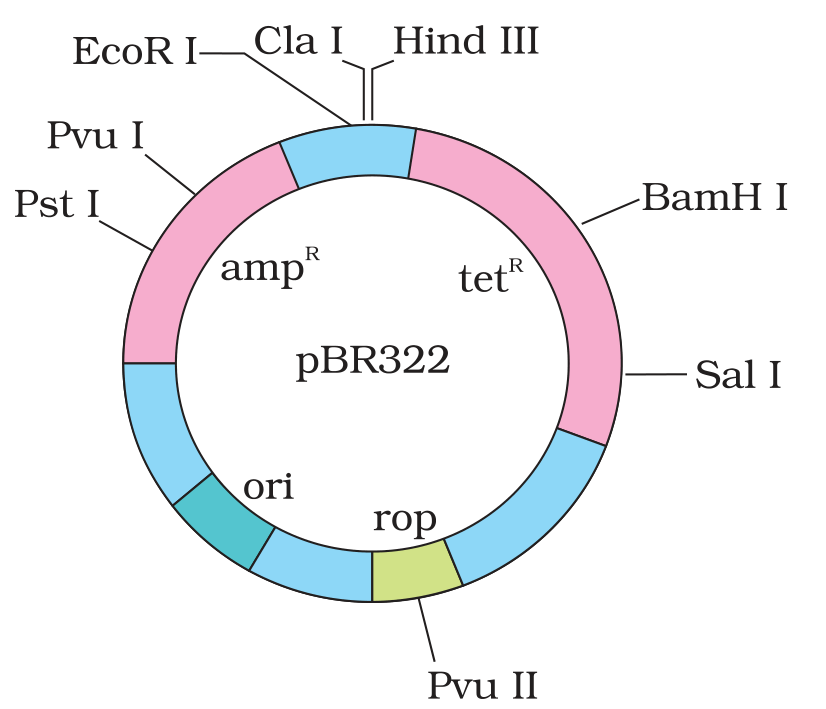
A selectable marker in a cloning vector, such as the ampicillin resistance gene of pBR322, helps in identifying and eliminating:

Answer & explanation+

Correct answer: option 1

The correct answer is Option (1) → Non-transformants

When DNA is put into bacteria (transformation), only a few cells take up the plasmid. These are the transformants; the rest are non-transformants. A selectable marker is a gene on the vector that lets the scientist tell them apart. Normal E. coli cells are not resistant to antibiotics, so an antibiotic resistance gene such as ampR works well as a marker.

Option (1) Non-transformants — Correct. On a medium with ampicillin, only cells that carry pBR322, with its ampR gene, can grow. Cells without the plasmid die and are eliminated. So the marker identifies and removes the non-transformants.

Option (2) Transformants — Incorrect. Transformants are the cells the marker allows to grow, since they carry the resistance gene. The marker keeps them; it does not eliminate them.

Option (3) Recombinants — Incorrect. Recombinants carry the plasmid too, so they also survive on ampicillin. They are told apart from non-recombinants by a second marker, such as the loss of tetracycline resistance when the foreign DNA is inserted into tetR.

Option (4) Cells with a high copy number of the plasmid — Incorrect. The number of copies of a plasmid in a cell is controlled by the origin of replication (ori), not by the selectable marker. Such cells also survive on ampicillin.

NCERT Extract:
Cloning Vectors – “… (ii) Selectable marker : In addition to ‘ori’, the vector requires a selectable marker, which helps in identifying and eliminating non-transformants and selectively permitting the growth of the transformants. Transformation is a procedure through which a piece of DNA is introduced in a host bacterium (you will study the process in subsequent section). Normally, the genes encoding resistance to antibiotics such as ampicillin, chloramphenicol, tetracycline or kanamycin, etc., are considered useful selectable markers for E. coli. The normal E. coli cells do not carry resistance against any of these antibiotics.”
Textbook figure

Figure 9.4 E. coli cloning vector pBR322 showing restriction sites (Hind III, EcoR I, BamH I, Sal I, Pvu II, Pst I, Cla I), ori and antibiotic resistance genes (ampR and tetR). rop codes for the proteins involved in the replication of the plasmid

Advertisement

Practise more on Biotechnology -Principles and Processes

Chapter-wise mocks on the real NTA exam screen, with solutions and your rank. Your first mocks are free.

Start free mocks →

Advertisement

Next questions

  1. In a region of space, the electric field is in the x-direction and proportional to x, i.e. E=E_o x i. Consider an imaginary cubical volume…Physics · Electrostatic Potential and Capacitance
  2. What was the approximate annual growth rate of the agriculture sector during 1991-2012, after the initiation of reforms?Economics · Indian Economic Development: Rural Development
  3. Physics · Atoms
  4. A concave mirror is placed on a horizontal table with its axis directed vertically upwards. Let O be the pole of the mirror and C its centr…Physics · Ray Optics
  5. The velocity of light in a medium depends onPhysics · Electromagnetic Waves
  6. The set of critical points of the function f(x) given by f(x)=x-log _e x+∫limits_2^x≤ft(1/t-2-2 cos 4 t) d t, isMaths. Section B1 · Applications of Derivatives
  7. Which of the following statements is correct? a- India ratified the Paris Climate Agreement on 2 October 2017.b- India signed and ratified…Political Science · Contemporary World Politics: Environment and Natural Resources
  8. Simplify ≤ft[≤ft(5 1/4 ÷ 3 1/2 × 5/12)-3/16] ÷≤ft(3 4/7 ÷ 5/14. of ≤ft.6 2/3) of 1 1/3.General Aptitude Test · Quantitative Reasoning
  9. Spread of health literacy is a type of __________. Which of the following options suits best in the above blank?Economics · Indian Economic Development: Human Capital Formation in India
  10. Let X denote the number of times heads occur in n tosses of a fair coin. If P(X=4), P(X=5) and P(X=6) are in AP, the value of n isMaths. Section B1 · Probability