Read the paragraph given below and answer the question.
Sutton and Boveri argued that the pairing and separation of a pair of chromosomes would lead to the segregation of a pair of factors they carried. Sutton united the knowledge of chromosomal segregation with Mendelian principles and called it the chromosomal theory of inheritance.
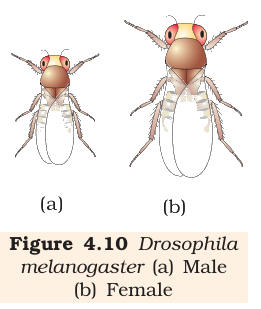
Following this synthesis of ideas, experimental verification of the chromosomal theory of inheritance by Thomas Hunt Morgan and his colleagues, led to discovering the basis for the variation that sexual reproduction produced. Morgan worked with the tiny fruit flies, which were found very suitable for such studies. They could be grown on simple synthetic medium in the laboratory. They complete their life cycle in a short span of time and a single mating could produce a large number of progeny flies. Also, there was a clear differentiation of the sexes - the male and female flies are easily distinguishable. Also, it has many types of hereditary variations that can be seen with low power microscopes.
Which statement is incorrect with respect to Drosophila.
Answer & explanation
Correct answer: option 4
The correct answer is Option (4) → Less number of variations in their population helps in better studying of traits
Option (1) Could be easily grown in laboratory — True of Drosophila. They grow on simple synthetic medium.
Option (2) Easily distinguishable male and female — True of Drosophila. Males and females are easily told apart.
Option (3) Large number of contrasting traits — True of Drosophila. They show many hereditary variations.
Option (4) Less number of variations in their population helps in better studying of traits — Not true. They have many types of hereditary variations, not few.
Note: The passage is taken from NCERT. NTA has put lines of the NCERT text together to make it. Most CUET (UG) questions come straight from NCERT, so study the book line by line, including figures and their titles.
NCERT Extract:
Chromosomal Theory of Inheritance – “… Morgan worked with the tiny fruit flies, Drosophila melanogaster (Figure 4.10), which were found very suitable for such studies. They could be grown on simple synthetic medium in the laboratory. They complete their life cycle in about two weeks, and a single mating could produce a large number of progeny flies. Also, there was a clear differentiation of the sexes – the male and female flies are easily distinguishable. Also, it has many types of hereditary variations that can be seen with low power microscopes.”