Hegemony as soft power implies
Answer & explanation
Correct answer: option 3
The correct answer is Option (3) → Capacity to Manufacture consent
Option (1) Military and Defence strategies — Incorrect. This is hegemony as hard power, the first meaning of the word: the relations, patterns and balances of military capability between states, as in the overwhelming military superiority of the US.
Option (2) Possession of Nuclear weapons — Incorrect. Nuclear weapons are part of a state’s military capability, so they too belong to hegemony as hard power.
Option (3) Capacity to Manufacture consent — Correct. The third sense of hegemony is the ideological or cultural one: the capacity to ‘manufacture consent’. A dominant power uses not only military power but also ideological resources, persuading weaker countries to view the world in a way that favours it. This is soft power: the ability to persuade rather than coerce.
Option (4) Economic Dominance — Incorrect. Economic dominance belongs to hegemony as structural power, the second notion: an open world economy needs a hegemon or dominant power to support its creation and existence.
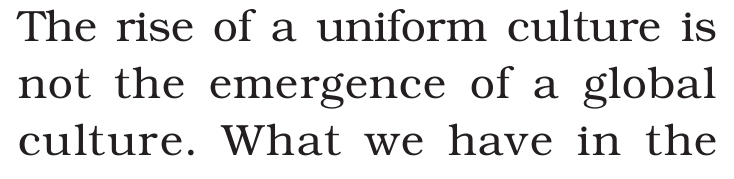
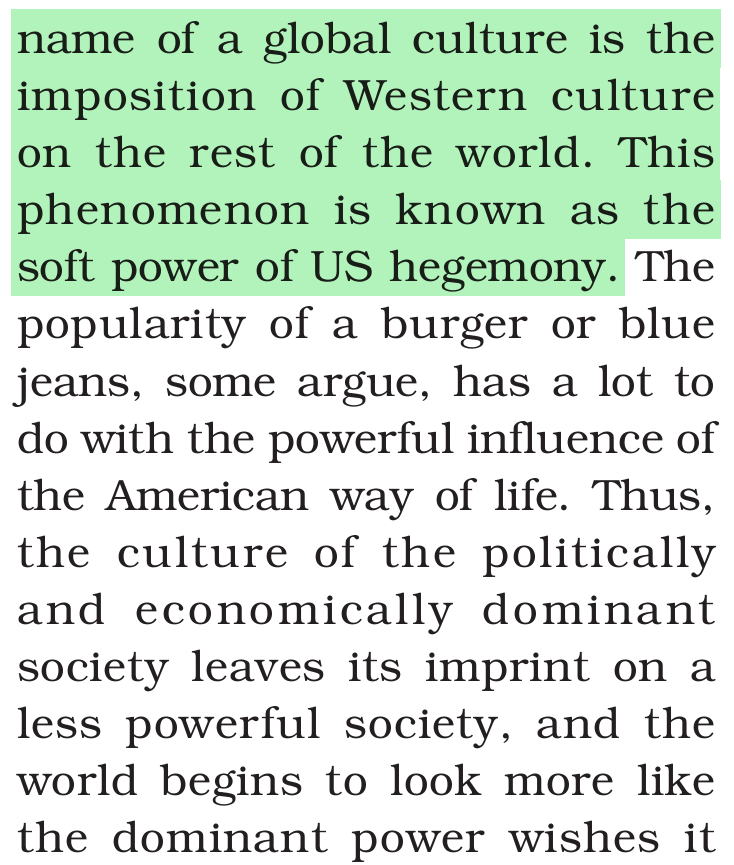
Note: This question is taken from the chapter ‘US Hegemony in World Politics’ which was there in the pre-rationalised NCERT and has been deleted from subsequent editions of NCERT, including the NCERT book (2026-27). The NCERT book (2026-27) still speaks of the ‘soft power of US hegemony’ in the chapter ‘Globalisation’, as the imposition of Western culture on the rest of the world, but not of the capacity to manufacture consent.
NCERT (2026-27): Contemporary World Politics — Chapter 7: Globalisation
NCERT (Pre-rationalised), chapter ‘US Hegemony in World Politics’: “Hegemony as Hard Power … Thus, the first meaning of hegemony relates to the relations, patterns and balances of military capability between states. It is this notion of hegemony as military preponderance that is especially germane to the current position and role of the US in world politics.…” NCERT (Pre-rationalised), chapter ‘US Hegemony in World Politics’: “Hegemony as Structural Power … The second notion of hegemony is very different from the first. It emerges from a particular understanding of the world economy. The basic idea is that an open world economy requires a hegemon or dominant power to support its creation and existence.…” NCERT (Pre-rationalised), chapter ‘US Hegemony in World Politics’: “Hegemony as Soft Power … It would however be a mistake to see US hegemony in purely military and economic terms without considering the ideological or the cultural dimension of US hegemony. This third sense of hegemony is about the capacity to ‘manufacture consent’. Here, hegemony implies class ascendancy in the social, political and particularly ideological spheres. Hegemony arises when the dominant class or country can win the consent of dominated classes, by persuading the dominated classes to view the world in a manner favourable to the ascendancy of the dominant class. Adapted to the field of world politics, this notion of hegemony suggests that a dominant power deploys not only military power but also ideological resources to shape the behaviour of competing and lesser powers. The behaviour of the weaker countries is influenced in ways that favour the interests of the most powerful country, in particular its desire to remain preeminent. Consent, in other words, goes hand-in-hand with, and is often more effective than, coercion. The predominance of the US in the world today is based not only on its military power and economic prowess, but also on its cultural presence. Whether we choose to recognise the fact or not, all ideas of the good life and personal success, most of the dreams of individuals and societies across the globe, are dreams churned out by practices prevailing in twentieth-century America. America is the most seductive, and in this sense the most powerful, culture on earth. This attribute is called ‘soft power’: the ability to persuade rather than coerce.…” |