
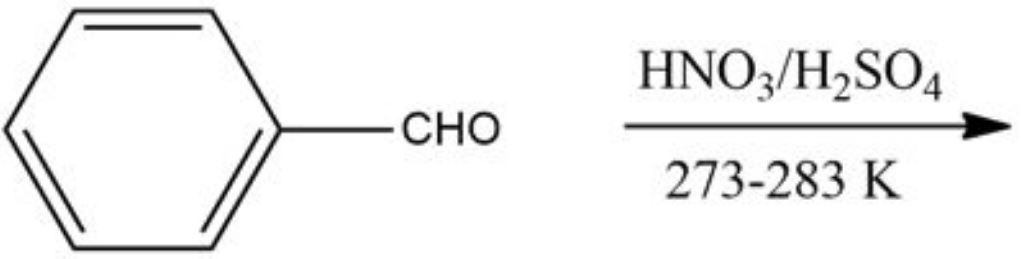
What is the product of the following reaction?
Answer & explanation
Correct answer: option 1
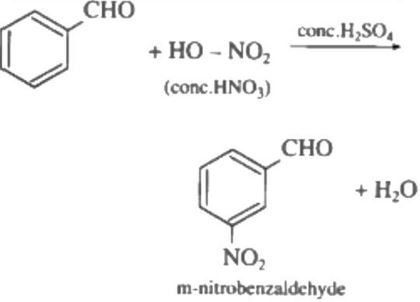
The correct answer is Option (1) → m-Nitrobenzaldehyde
The given reaction involves nitration of benzaldehyde using a mixture of concentrated nitric acid and concentrated sulphuric acid, which is known as the nitrating mixture.
This mixture generates the nitronium ion (NO₂⁺), which acts as the electrophile in the electrophilic aromatic substitution reaction.
Formation of electrophile:
HNO₃ + H₂SO₄ → NO₂⁺ + HSO₄⁻ + H₂O
The nitronium ion (NO₂⁺) then attacks the aromatic ring.
Directing effect of –CHO group
The –CHO (aldehyde) group is:
- Electron withdrawing due to the −I effect and −M effect
- Deactivating toward electrophilic substitution
Because of this electron-withdrawing nature, the –CHO group directs incoming electrophiles to the meta position.
Thus nitration of benzaldehyde predominantly gives:
m-Nitrobenzaldehyde
Option-wise Explanation
Option 1: m-Nitrobenzaldehyde
The –CHO group is a meta-directing deactivating group, so nitration occurs mainly at the meta position relative to the aldehyde group. Therefore this option is correct.
Option 2: p-Nitrobenzaldehyde
Although para substitution is possible with activating groups, the –CHO group strongly deactivates the ortho and para positions, making meta substitution preferred. Hence this option is incorrect.
Option 3: m-Sulphonatobenzaldehyde
Sulphonation would require fuming sulphuric acid (SO₃ / H₂SO₄), not nitric acid. Since the reaction conditions indicate nitration, this option is incorrect.
Option 4: Benzoic acid
Benzoic acid would be formed by oxidation of the aldehyde group, not by nitration. Therefore this option is incorrect.