
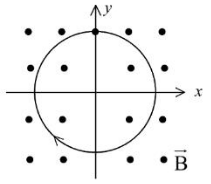
A conducting loop carrying a current I is placed in a uniform magnetic field pointing outward of the plane as shown. The loop will have a tendency to:
Answer & explanation
Correct answer: option 1
The correct answer is Option (1) → Contract
Each element of the loop feels the magnetic force \( d\vec{F} = I\,d\vec{l}\times\vec{B} \).
The dots show \( \vec{B} \) out of the page (along \( +z \)). The arrowhead on the lower left of the loop points up and to the left, so the current flows clockwise.
At the top of the loop the current is along \( +x \):
\( d\vec{F} \propto \hat{\imath}\times\hat{k} = -\hat{\jmath} \)
This force points towards the centre. The same happens at every point of a clockwise loop in this field, so the forces all act radially inward and the loop tends to contract.
Option (2) Expand — Incorrect. The loop would expand only if the current were anticlockwise, which reverses every force to outward.
Option (3) Move towards x axis — Incorrect. In a uniform field the forces on a closed loop add up to zero, so the loop does not move as a whole.
Option (4) Move towards -x axis — Incorrect. Same reason: the net force on a closed current loop in a uniform field is zero.
Shortcut: A clockwise current seen from the front gives a magnetic moment into the page, opposite to \( \vec{B} \). A loop whose moment is opposite to the field tends to contract; one whose moment is along the field tends to expand.