Match List - I with List - II.
| List - I (Demographic feature) | List - II (Country) | ||
| (A) | Very High fertility rate | (I) | India and Pakistan |
| (B) | One Child Norm | (II) | Pakistan |
| (C) | High density of population | (III) | China |
| (D) | Mixed economy | (IV) | India |
Choose the correct answer from the options given below :
Answer & explanation
Correct answer: option 2
The correct answer is Option (2) → (A) - (II), (B) - (III), (C) - (IV), (D) - (I)
The fertility rate is the average number of children born to a woman. The density of population is the number of people per square kilometre.
| List-I | List-II | Reason |
|---|---|---|
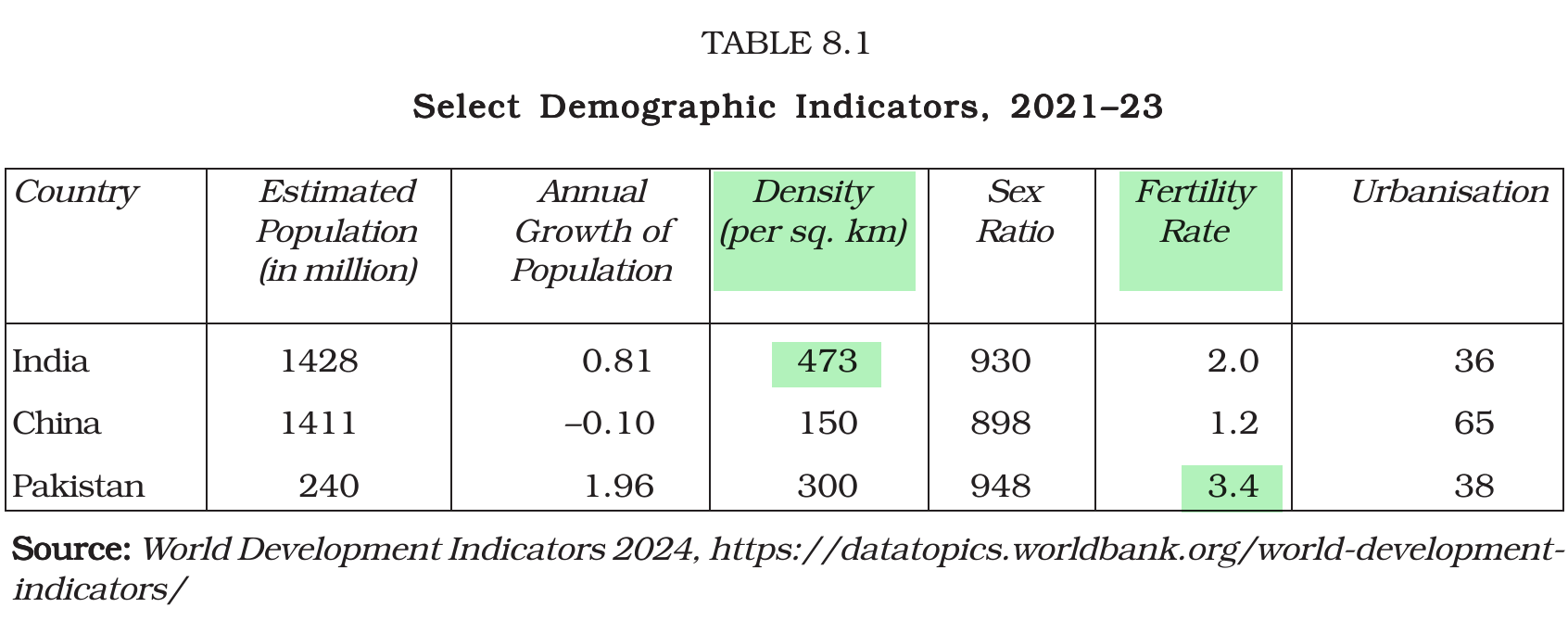
| (A) Very High fertility rate | (II) Pakistan | Pakistan has the highest rate: 3.4, against 2.0 in India and 1.2 in China. |
| (B) One Child Norm | (III) China | This norm arrested the growth of population in China. |
| (C) High density of population | (IV) India | India has the highest density: 473 per sq. km, against 300 in Pakistan and 150 in China. |
| (D) Mixed economy | (I) India and Pakistan | In both countries the public and private sectors exist side by side. |
NCERT (2026-27): “8.3 Demographic Indicators … Though China is the largest nation and geographically occupies the largest area among the three nations, its density is the lowest.… …Scholars point out the one-child norm introduced in China in the late 1970s as the major reason for low population growth.… …The fertility rate is also low in China and very high in Pakistan.… …Pakistan: While looking at various economic policies that Pakistan adopted, you will notice many similarities with India. Pakistan also follows the mixed economy model with co-existence of public and private sectors.…” NCERT (2026-27), chapter ‘Liberalisation, Privatisation and Globalisation: An Appraisal’: “…You have studied in the previous chapter that, since independence, India followed the mixed economy framework by combining the advantages of the capitalist economic system with those of the socialist economic system.…”
|