
Why is it important for vectors to have few or single recognition sites for restriction enzymes?
Answer & explanation
Correct answer: option 2
The correct answer is Option (2) → To simplify the gene cloning process
To insert a gene, the vector is cut open with a restriction enzyme at its recognition site, and the alien DNA is joined there. If the vector has only one site for that enzyme, it opens at one point and stays in one piece. If it has several sites, it breaks into several fragments.
Option (1) To generate several fragments for gene cloning — Incorrect. Several fragments are the problem, not the goal. More than one recognition site breaks the vector into pieces, and the gene cannot be inserted cleanly.
Option (2) To simplify the gene cloning process — Correct. With very few, preferably single, recognition sites, the vector is cut at one place only. The alien DNA goes into that site, and cloning stays simple.
Option (3) To increase the efficiency of DNA replication — Incorrect. Replication of the vector is controlled by the origin of replication (ori), which also sets the copy number. Recognition sites do not change it.
Option (4) To facilitate transformation of bacteria — Incorrect. Transformation is helped by making the host cells competent. The number of recognition sites in the vector has no role in it.
NCERT Extract:
Cloning Vectors – “… (i) Origin of replication (ori) : This is a sequence from where replication starts and any piece of DNA when linked to this sequence can be made to replicate within the host cells. … (iii) Cloning sites: In order to link the alien DNA, the vector needs to have very few, preferably single, recognition sites for the commonly used restriction enzymes. Presence of more than one recognition sites within the vector will generate several fragments, which will complicate the gene cloning (Figure 9.4).”
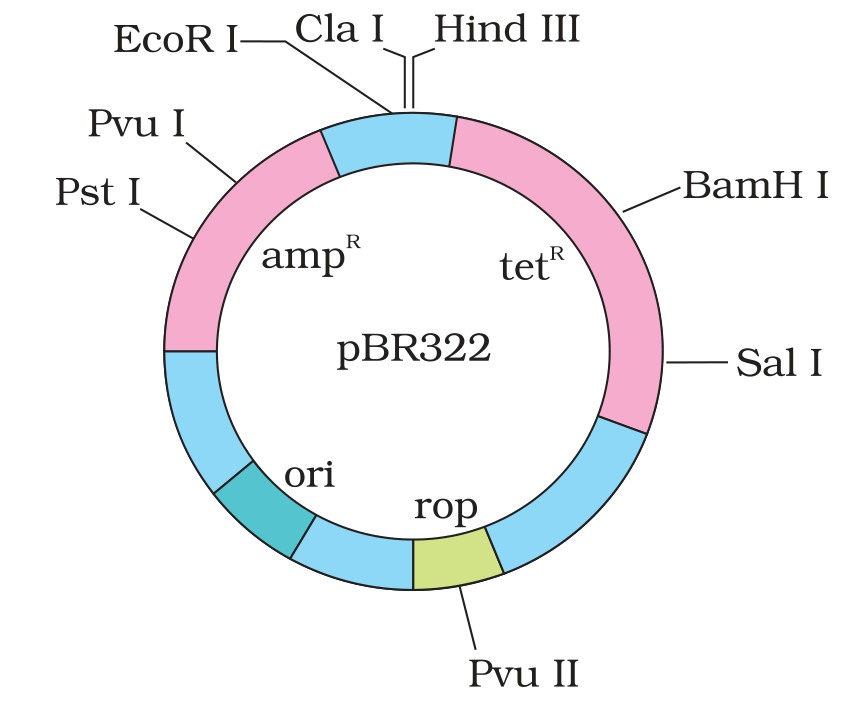
Figure 9.4 E. coli cloning vector pBR322 showing restriction sites (Hind III, EcoR I, BamH I, Sal I, Pvu II, Pst I, Cla I), ori and antibiotic resistance genes (ampR and tetR). rop codes for the proteins involved in the replication of the plasmid.