
A merchant plans to sell two types of personal computers-a desktop model and a portable model that will cost ₹25000 and ₹40000 respectively. He estimates that the total monthly demand of computers will not exceed 250 units. Determine the number of units of each type of computers which the merchant should stock to get maximum profit, if he does not want to invest more than ₹70 lakhs and his profit on desktop model is ₹4500 and on portable model is ₹5000. Make an LPP and solve it graphically using iso-profit/iso-cost method.
Answer & explanation
Correct answer: option 3
The correct answer is Option (3) → Stock 200 desktop models and 50 portable models for a maximum profit of ₹1,150,000.
Let x and y be the number of desktop and portable models respectively that the merchant should stock, then the problem can be formulated as an LPP as follows:
Maximise profit (in ₹) $Z = 4500x + 5000y$ Subject to constraints
$x + y ≤250$ (demand constraint)
$25000x + 40000y ≤7000000$ (investment constraint)
or $5x+8y ≤ 1400$
$x≥0, y ≥0$ (non-negativity constraints)
Draw the lines $x + y = 250$ and $5x + 8y = 1400$ and shade the region satisfied by the above inequalities. The feasible region OABC is bounded. The corner points are O(0, 0), A(250, 0), B(200, 50) and C(0, 175).
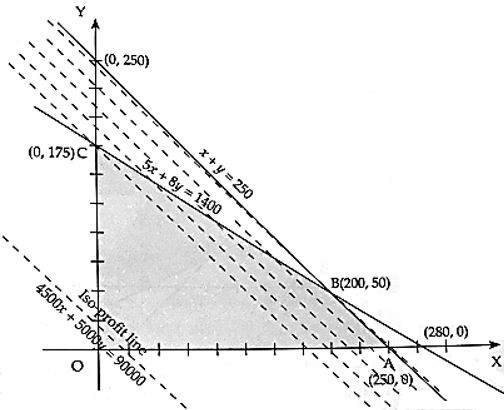
Now, let us give some value to Z, say 90000 and draw a dotted line $4500x + 5000y = 90000$ which is called iso-profit line. Move this iso-profit line parallel to itself over the feasible region. It passes through all corner points one by one. The farthest corner point it crosses is B(200, 50) which gives us the optimal solution
$Z = 4500 × 200 + 5000 × 50$
i.e. $Z = ₹1150000$
So, we find that the maximum value of Z occurs at B(200, 50) and maximum value = ₹1150000. Hence, for maximum profit, number of desktop models = 200 and number of portable models = 50 and the maximum profit is ₹1150000.