
CUETMOCK
  • Pricing
  • Mentors
Log inStart freeStart free mocks→

First test, then trust

Try a free CUET mock test.

Join 5,00,000+ students who rehearsed exam day on the exact NTA screen before sitting CUET. On the web and on Android.

Start free mocks →Get the Android app
CUETMOCK

India's #1 CUET Mock Test Platform. Original NCERT-based questions on the exact NTA exam screen — trusted by 5,00,000+ students since CUET 2022.

Get it onGoogle PlayScan to download the CUETMOCK app

Mock tests

  • CUET mock test series
  • Browse all papers
  • Commerce mocks
  • Humanities (Arts) mocks
  • Science mocks
  • Languages & GAT mocks
  • Free practice questions
  • Pricing

Resources

  • CUET exam guide
  • CUET syllabus
  • Universities accepting CUET
  • Expert blogs
  • News & notifications
  • Webinars & counselling
  • CUET score calculator
  • How we estimate your rank
  • FAQs

Company

  • About us
  • Our leadership & team
  • Our toppers
  • Mentors
  • For schools
  • Contact us
  • Terms
  • Privacy
  • Refund policy

Talk to us

+91 7696 6630 56info@cuetmock.comWhatsApp us

Our other platforms

  • JEE Mock — For IIT-JEE aspirants
  • NEET Mock — For NEET aspirants

Newsletter

Exam updates, study material and offers — no spam.

© 2026 NYC Ventures Pvt. Ltd.

701-702, Royal Business Park, Zirakpur, Punjab - 140603

  • Terms of use
  • Privacy policy
  • Refund policy
  • Contact us

iCUETMOCK is an independent preparation platform, not affiliated with the National Testing Agency (NTA). Always check exam details on the official NTA website.

  • Home
  • Mock tests
  • CUET guide
  • Pricing
  • Log in
Home/Practice questions/Chemistry
ChemistryOrganic: Chemistry in Everyday Life

Identify the cationic detergent from the following.

Two types of detergents are used as cleansing agents. These are soaps and synthetic detergents. These improve cleansing properties of water. These help in removal of fats which bind other materials to the fabric or skin.
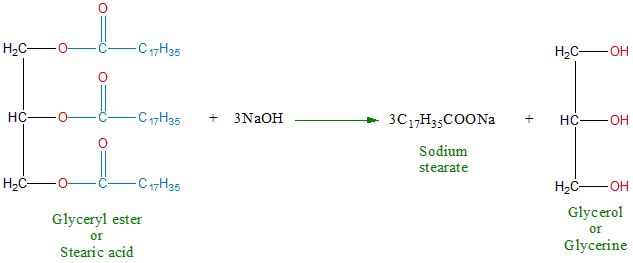
Soaps are the detergents used since long. Soaps used for cleaning purpose are sodium or potassium salts of long chain fatty acids, e.g., stearic, oleic and palmitic acids. Soaps containing sodium salts are formed by heating fat (i.e., glyceryl ester of fatty acid) with aqueous sodium hydroxide solution. This reaction is known as saponification.

Identify the cationic detergent from the following.

Answer & explanation+

Correct answer: option 1

The correct answer is option 1. Cetyltrimethylammonium bromide.

Cationic detergents are a type of surfactant (surface-active agent) that contain a positively charged hydrophilic (water-attracting) head group. This positively charged head group is attracted to negatively charged surfaces, such as those found on dirt, grease, and other contaminants, facilitating their removal from surfaces.

One example of a cationic detergent is cetyltrimethylammonium bromide (CTAB). CTAB has a long hydrophobic tail and a positively charged quaternary ammonium head group. The long hydrophobic tail is typically derived from a long carbon chain, such as cetyl (hexadecyl), which provides the surfactant with its ability to dissolve nonpolar substances, such as oils and fats.

In aqueous solutions, CTAB molecules form micelles, which are spherical aggregates where the hydrophobic tails are shielded from water by the hydrophilic head groups. These micelles can solubilize nonpolar substances, allowing them to be washed away.

Cationic detergents like CTAB are commonly used in various applications, including:

1. Laboratory Research: CTAB is often used in molecular biology and biochemistry laboratories for DNA and protein purification, as it can solubilize and separate biomolecules based on their charge.

2. Personal Care Products: Cationic detergents are found in many personal care products, such as shampoos, conditioners, and body washes, where they help to cleanse the skin and hair by removing dirt and oils.

3. Industrial Applications: Cationic detergents are used in industrial settings for cleaning and sanitizing purposes, as well as in the production of textiles, paper products, and household cleaning agents.

Overall, cationic detergents like CTAB play an important role in cleaning and sanitation by effectively removing contaminants from surfaces through their surfactant properties.

Advertisement

Practise more on Organic: Chemistry in Everyday Life

Chapter-wise mocks on the real NTA exam screen, with solutions and your rank. Your first mocks are free.

Start free mocks →

Advertisement

Next questions

  1. What will be the new proprietary ratio (0.6:1) of the company if the sale of a fixed asset costing ₹200000 for ₹250000 makes by the company?Accountancy Part B · Accounting Ratios
  2. Payment made to others for the purchase of factors of production is known as ______.General Aptitude Test · General Knowledge
  3. In the following question below are given some statements followed by some conclusions based on those statements. Taking the given statemen…General Aptitude Test · Verbal Reasoning
  4. For the system […] […] = […] , which of the following statements are correct? (A) The system has no solution.(B) The system is consistent.(…Applied Maths. Section B2 · Algebra
  5. Among five boys, V is taller than M, but not as tall as R. J is taller than D but shorter than M. Who is tallest in the group?General Aptitude Test · Verbal Reasoning
  6. A was born on Tuesday . Whereas, B was born after 313 days to A . What was the day when B was born?General Aptitude Test · Verbal Reasoning
  7. Who among the following personalities is a Padma Vibhushan, legendary Indian Classical Dancer behind reviving the classical dance form of O…General Aptitude Test · General Knowledge
  8. During the Cold War in which year did USSR and Communist China fight a brief war over a territorial dispute?Political Science · Contemporary World Politics: The Cold War Era
  9. What will be the gain of C on the retirement of B?Accountancy Part A · Reconstitution of Partnership Firm: Retirement and Death
  10. The following pie charts show the number of start-ups started in various sectors since 2016 and the number of successful startups in those…General Aptitude Test · Quantitative Reasoning