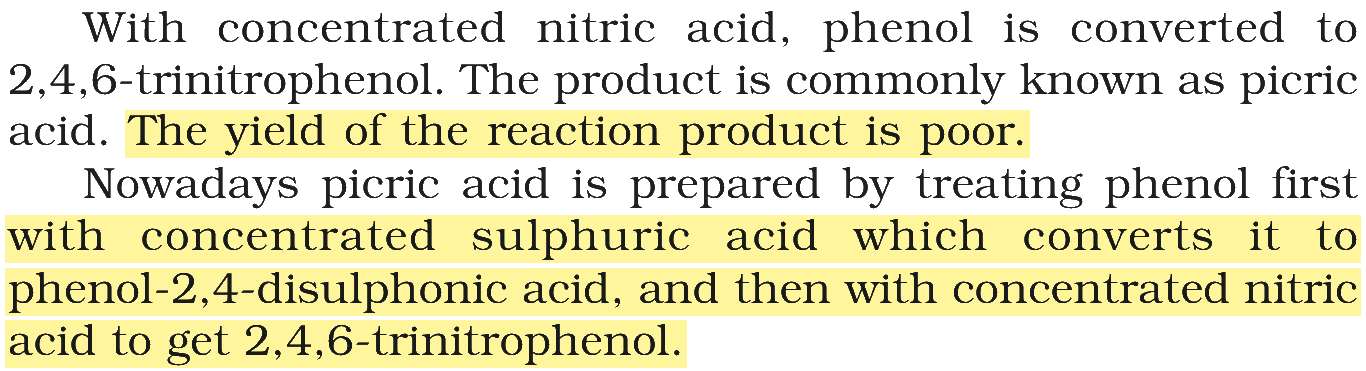
Predict the products, A and B in the following reaction sequence:
Answer & explanation
Correct answer: option 2
The correct answer is Option (2) → A = phenol-2,4-disulphonic acid, B = 2,4,6-trinitrophenol (picric acid)
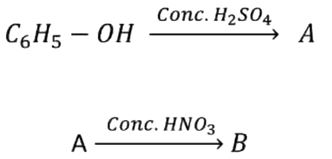
The –OH group strongly activates the ring at its ortho and para positions, so picric acid is made in two stages: sulphonation first, then nitration.
Concentrated sulphuric acid puts –\( \ce{SO3H} \) groups at the two activated positions 2 and 4, giving phenol-2,4-disulphonic acid (A). These electron-withdrawing groups make the ring less easily oxidised:
\( \displaystyle \ce{C6H5OH + 2H2SO4} \xrightarrow{\text{conc.}} \ce{C6H3(OH)(SO3H)2 + 2H2O} \)
Concentrated nitric acid then replaces both –\( \ce{SO3H} \) groups by –\( \ce{NO2} \) groups and nitrates the remaining ortho position (6), giving 2,4,6-trinitrophenol (B), picric acid:
\( \displaystyle \ce{C6H3(OH)(SO3H)2 + 3HNO3} \xrightarrow{\text{conc.}} \ce{C6H2(OH)(NO2)3 + 2H2SO4 + H2O} \)
So A is phenol-2,4-disulphonic acid and B is picric acid, the pair in Option (2). Three nitro groups make picric acid a strong acid.
Why the other options are incorrect
Option (1) A = phenol-2,4-disulphonic acid, B = 2,4-dinitrophenol — Incorrect. A is right, but concentrated nitric acid also nitrates the free position 6, so the product carries three nitro groups.
Option (3) A = 4-hydroxybenzenesulphonic acid, B = 2,4-dinitrophenol — Incorrect. With concentrated sulphuric acid both activated positions, 2 and 4, are sulphonated; and the nitration goes on to the trinitro compound.
Option (4) A = 4-hydroxybenzenesulphonic acid, B = 4-hydroxy-3-nitrobenzenesulphonic acid — Incorrect. Concentrated nitric acid does not stop at one nitro group; it replaces the –\( \ce{SO3H} \) groups as well and gives picric acid.
NCERT (2026-27 edition):
Electrophilic Aromatic Substitution – …