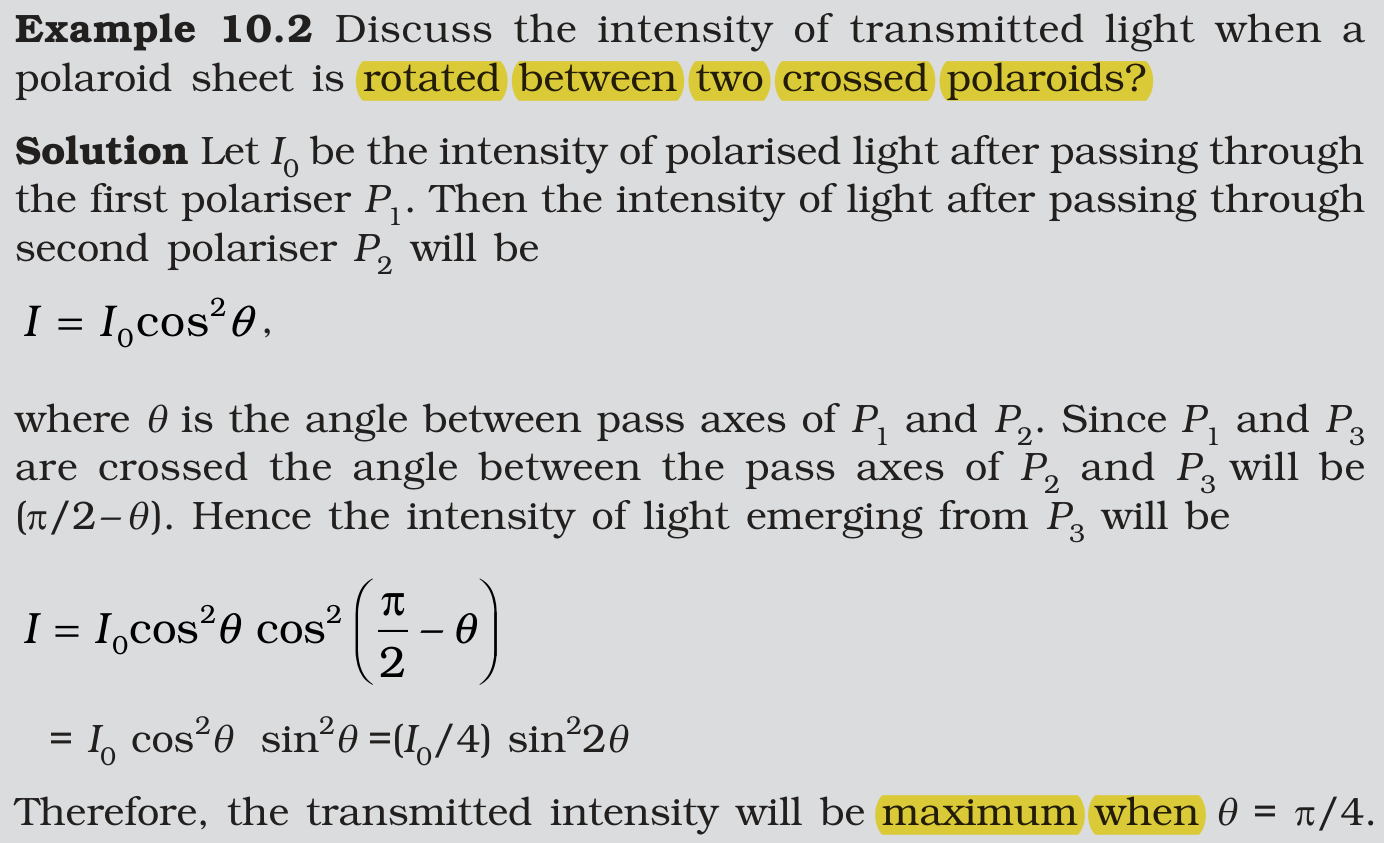
Two polaroids \( P_1 \) and \( P_2 \) are set in crossed positions. A third polaroid \( P_3 \) is placed between the two making an angle \( \alpha \) with the axis passing from the first polaroid \( P_1 \). In what orientation will the transmitted intensity be maximum?
Answer & explanation
Correct answer: option 3
The correct answer is Option (3) → \( \frac{\pi}{4} \)
Unpolarised light of intensity \( I_0 \) loses half its intensity at the first polaroid. After that each polaroid follows Malus's law, \( I = I'\cos^{2}\theta \), where \( \theta \) is the angle between the plane of the light and the axis of the polaroid.
\( \text{After } P_1: \ I_1 = I_0/2 \)
\( \text{After } P_3 \text{ (angle } \alpha \text{)}: \ I_2 = I_1\cos^{2}\alpha \)
\( P_2 \) is crossed with \( P_1 \), so the angle between \( P_3 \) and \( P_2 \) is \( 90^\circ - \alpha \).
\( \displaystyle I_3 = I_2\cos^{2}(90^\circ - \alpha) = \frac{I_0}{2}\cos^{2}\alpha\,\sin^{2}\alpha = \frac{I_0}{8}\sin^{2}2\alpha \)
The intensity is maximum when \( \sin 2\alpha = 1 \), that is \( 2\alpha = \pi/2 \).
\( \displaystyle \alpha = \frac{\pi}{4}, \qquad I_{\max} = \frac{I_0}{8} \)
Note: This question is from NCERT (2026-27). NTA sets numerical questions from NCERT too, so do not ignore NCERT while practising numericals.
NCERT (2026-27):
Polarisation – …