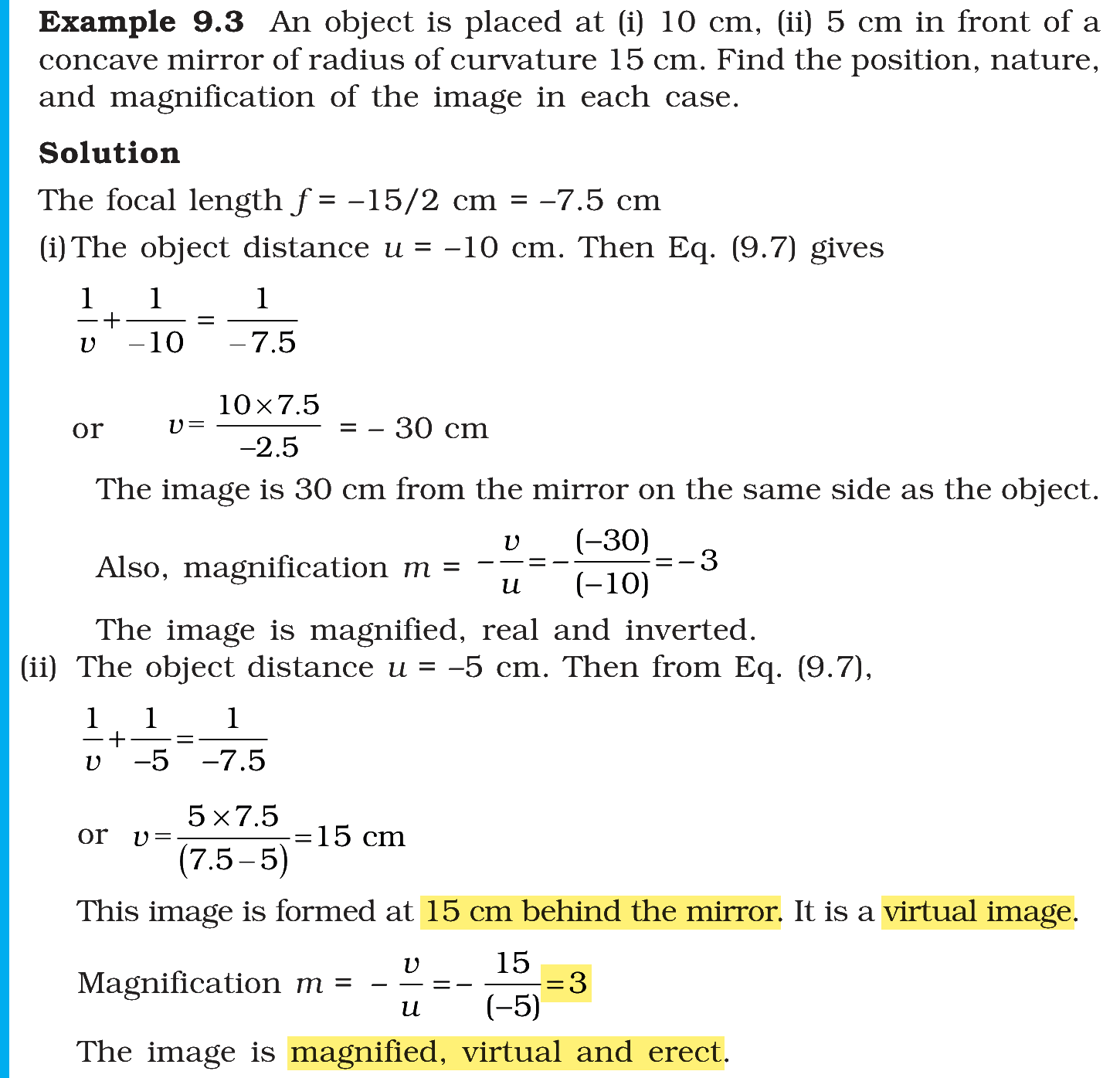
An object is placed at a distance of 5 cm in front of a concave mirror of radius of curvature 15 cm. What are the magnification and the nature of the image?
Answer & explanation
Correct answer: option 4
The correct answer is Option (4) → 3, virtual and erect
The image follows from the mirror equation \( 1/v+1/u=1/f \) and the magnification \( m=-v/u \). We use the Cartesian sign convention. Distances are measured from the pole, and those in front of the mirror are negative. A concave mirror has a negative focal length, \( f=-R/2 \).
\( u=-5\,\mathrm{cm} \)
\( \begin{aligned} f &= -\frac{R}{2} \\ &= -\frac{15\,\mathrm{cm}}{2} \\ &= -7.5\,\mathrm{cm} \end{aligned} \)
The image distance is:
\( \begin{aligned} \frac{1}{v} &= \frac{1}{f}-\frac{1}{u} \\ &= \frac{1}{-7.5\,\mathrm{cm}}-\frac{1}{-5\,\mathrm{cm}} \\ &= \frac{-2+3}{15\,\mathrm{cm}} \\ &= \frac{1}{15\,\mathrm{cm}} \end{aligned} \)
\( v=+15\,\mathrm{cm} \)
The magnification is:
\( \begin{aligned} m &= -\frac{v}{u} \\ &= -\frac{15\,\mathrm{cm}}{-5\,\mathrm{cm}} \\ &= 3 \end{aligned} \)
The positive \( v \) places the image 15 cm behind the mirror. The reflected rays only appear to come from there, so the image is virtual. The positive \( m \) means it is erect and three times the size of the object.
NCERT (2026-27):
Example 9.3