
In the Hershey and Chase experiment, bacteria that were infected with viruses grown on a medium containing radioactive sulfur were not radioactive after blending and centrifugation. What does this result indicate?
Answer & explanation
Correct answer: option 1
The correct answer is Option (1) → Proteins from the viruses did not enter the bacteria.
Hershey and Chase wanted to know whether the protein or the DNA of a bacteriophage enters the bacterium. They labelled the two parts separately. Sulfur is present in protein but not in DNA, so radioactive sulfur marks only the protein coat. Phosphorus is present in DNA but not in protein, so radioactive phosphorus marks only the DNA. After infection, blending removed the viral coats from the bacteria, and centrifugation separated the virus particles from the bacteria.
Option (1) Proteins from the viruses did not enter the bacteria. — Correct. In the sulfur batch, only the viral protein was radioactive. The bacteria had no radioactivity after blending and centrifugation, so the labelled protein stayed outside and was removed with the viral coats.
Option (2) DNA from the viruses did not enter the bacteria. — Incorrect. Sulfur does not label DNA, so this batch tells us nothing about DNA. The phosphorus batch answered that point: those bacteria were radioactive, showing that viral DNA did enter.
Option (3) The viruses failed to attach to the bacteria. — Incorrect. The radioactive phages were allowed to attach and infect the bacteria; the coats were knocked off later by the blender. In the phosphorus batch, the same steps gave radioactive bacteria, so the phages did attach and inject their material.
Option (4) The viral proteins carried the genetic material into the bacteria. — Incorrect. If protein had entered, the bacteria in the sulfur batch would have been radioactive. They were not, so protein did not go in and was not the genetic material.
NCERT Extract:
The Genetic Material is DNA – “… They grew some viruses on a medium that contained radioactive phosphorus and some others on medium that contained radioactive sulfur. Viruses grown in the presence of radioactive phosphorus contained radioactive DNA but not radioactive protein because DNA contains phosphorus but protein does not. Similarly, viruses grown on radioactive sulfur contained radioactive protein but not radioactive DNA because DNA does not contain sulfur.”
The Genetic Material is DNA – “… Bacteria which was infected with viruses that had radioactive DNA were radioactive, indicating that DNA was the material that passed from the virus to the bacteria. Bacteria that were infected with viruses that had radioactive proteins were not radioactive. This indicates that proteins did not enter the bacteria from the viruses. DNA is therefore the genetic material that is passed from virus to bacteria (Figure 5.5).”
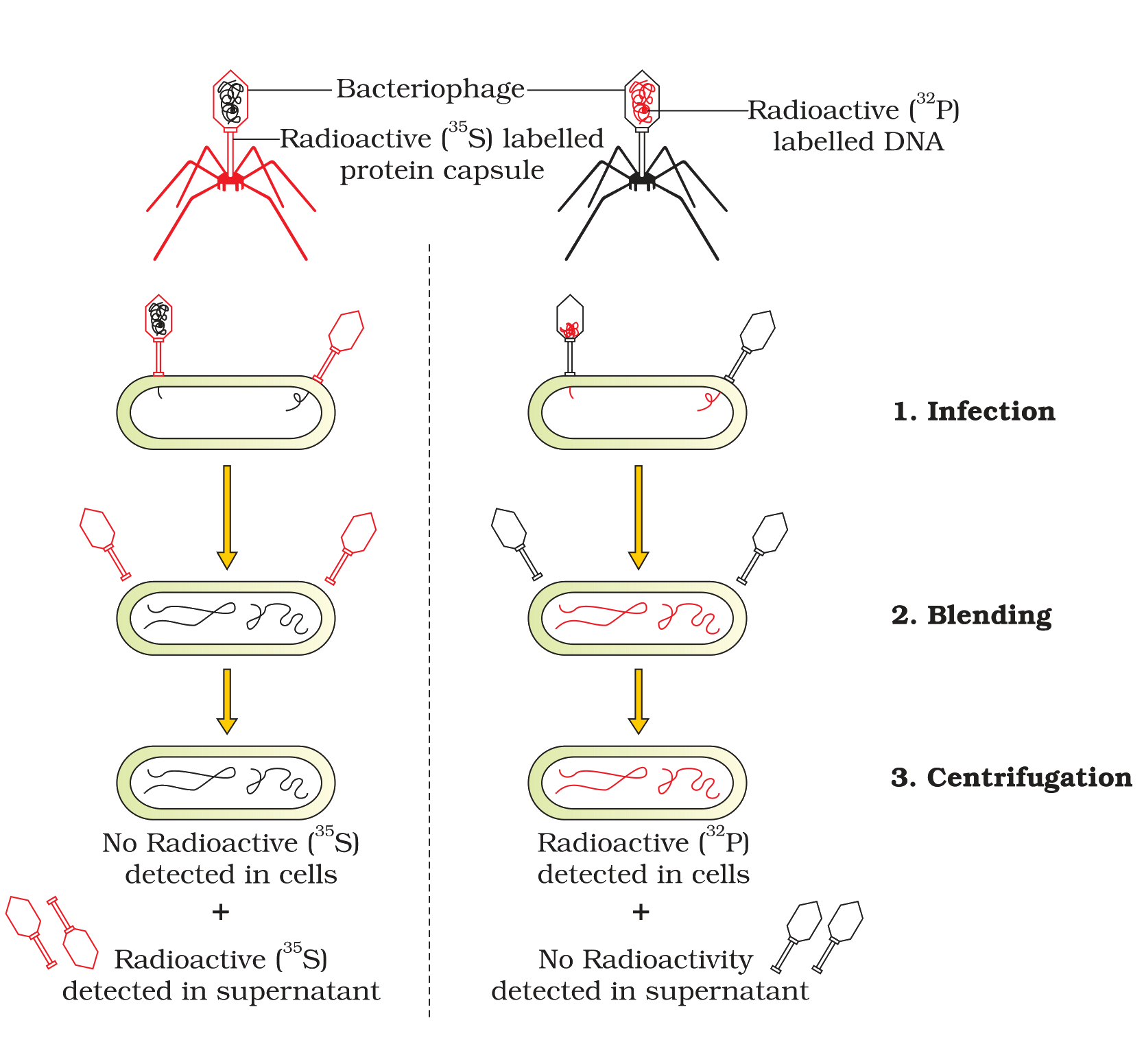
Figure 5.5 The Hershey-Chase experiment