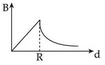
A cylinder of radius R is carrying a constant current. The correct plot of magnetic field with distance (d) from the axis of the cylinder is:
Answer & explanation
Correct answer: option 2
The correct answer is Option (2)
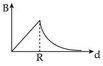
Apply Ampere's law to a circle of radius d about the axis, taking the current to be spread uniformly over the cross-section of the cylinder.
Inside (\( d \lt R \)): the enclosed current is \( I\,d^{2}/R^{2} \), so
\( \displaystyle B\,(2\pi d) = \mu_0\,\frac{I d^{2}}{R^{2}} \Rightarrow B = \frac{\mu_0 I}{2\pi R^{2}}\,d \)
B rises in a straight line from zero at the axis, \( B\propto d \).
Outside (\( d \gt R \)): the whole current I is enclosed, so
\( \displaystyle B = \frac{\mu_0 I}{2\pi d} \)
B falls as \( 1/d \) towards zero. At \( d = R \) both expressions give \( \mu_0I/2\pi R \), so the curve is continuous with its peak at \( d = R \).
Why the other options are incorrect
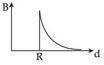
Option (1) — Incorrect. The field is zero inside and jumps at \( d = R \). That is the pattern for a current on the surface only (a hollow cylinder), not a current spread through the cylinder.
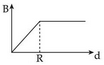
Option (3) — Incorrect. The field stays constant outside, but it must fall as \( 1/d \).
Option (4) — Incorrect. The rise inside is right, but outside the curve levels off at a non-zero value instead of continuing to fall towards zero as \( 1/d \).
NCERT (2026-27):
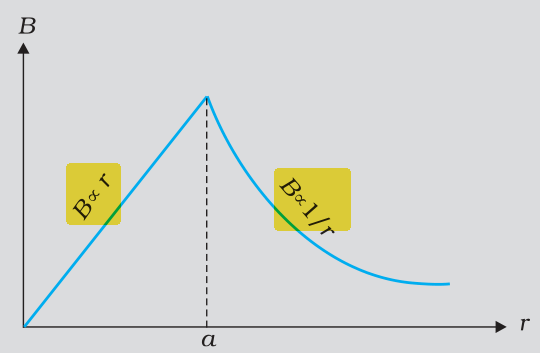
Ampere’s Circuital Law – “… Example 4.7 Figure 4.13 shows a long straight wire of a circular cross-section (radius a) carrying steady current I. The current I is uniformly distributed across this cross-section. Calculate the magnetic field in the region r < a and r > a.”
Ampere’s Circuital Law – “… Figure (4.14) shows a plot of the magnitude of B with distance r from the centre of the wire.”