Read the passage carefully and answer the given questions.
DNA fingerprinting
Polymorphism in DNA sequence is the basis of genetic mapping of the human genome as well as of DNA fingerprinting. DNA fingerprinting involves identification of differences in some specific regions in the DNA sequence called repetitive DNA. It works on the principle of polymorphisms in DNA sequences. The repetitive DNA are separated from bulk genomic DNA. The bulk DNA forms a major peak and the other small peaks are referred to as satellite DNA. These repetitive/satellite DNA sequences show a high degree of polymorphisms and form the basis of DNA fingerprinting.
DNA fingerprinting is meant for:
Answer & explanation
Correct answer: option 2
The correct answer is Option (2) → Quick way to compare DNA sequences
Option (1) Slow way to compare DNA sequences — Incorrect. This is the reverse of the point. The slow way is to sequence the whole DNA of each person. DNA fingerprinting avoids that and looks only at the repetitive regions.
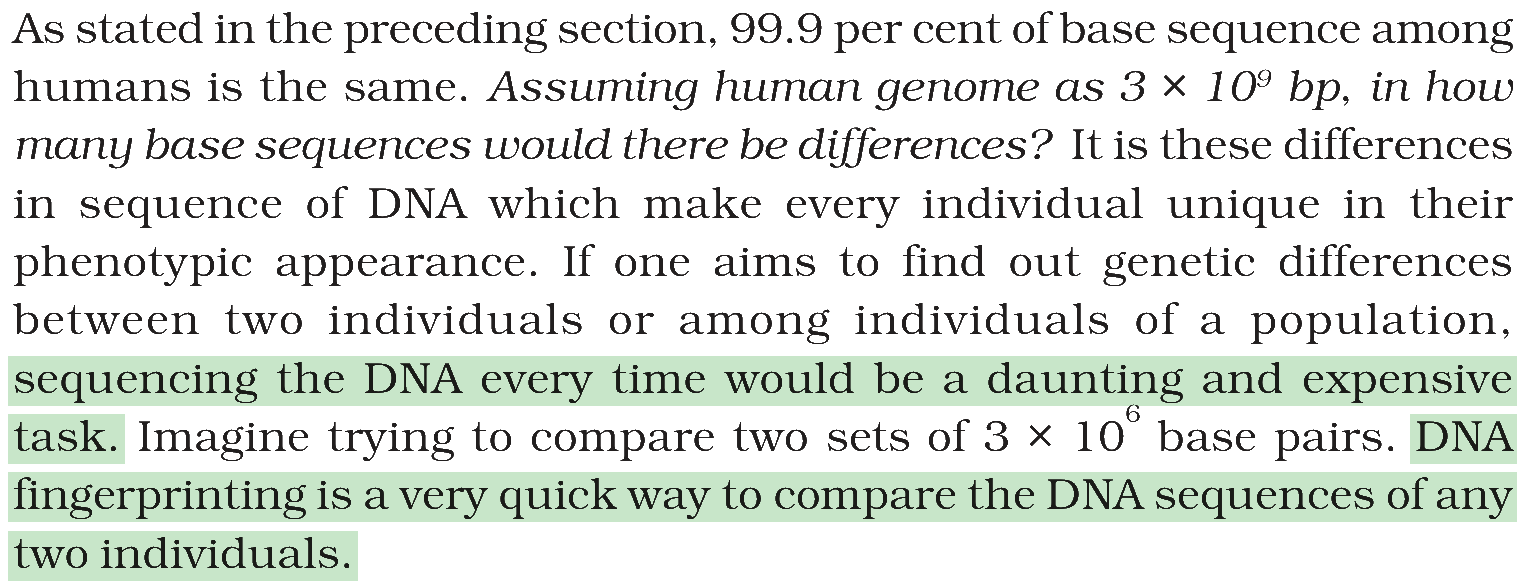
Option (2) Quick way to compare DNA sequences — Correct. Sequencing about 3 billion base pairs every time would be costly and slow. DNA fingerprinting compares only the repetitive DNA, so the difference between two people shows up fast.
Option (3) Identifying similarities in some specific regions in DNA — Incorrect. DNA fingerprinting looks for differences, not similarities, in the repetitive regions. 99.9 per cent of the base sequence is the same in all humans, so similarities cannot tell people apart.
Option (4) Identify mutations — Incorrect. Polymorphism does arise from mutations. But DNA fingerprinting compares the band patterns of individuals; it is not a test to find a mutation.
Note: The passage is taken from NCERT. NTA has put lines of the NCERT text together to make it. Most CUET (UG) questions come straight from NCERT, so study the book line by line, including figures and their titles.
NCERT Extract:
DNA Fingerprinting –