"First of all I would look at it as not rupee sliding, I would look at it as dollar strengthening, dollar strengthening incessantly," said Nirmala Sitharaman after attending the Annual meetings of the IMF and the World Bank.
Based on the above passage, answer the questions mentioned below :
An exchange rate which is determined by the market forces of demand and supply of foreign exchange :
Answer & explanation
Correct answer: option 2
The correct answer is Option (2) → Flexible exchange rate
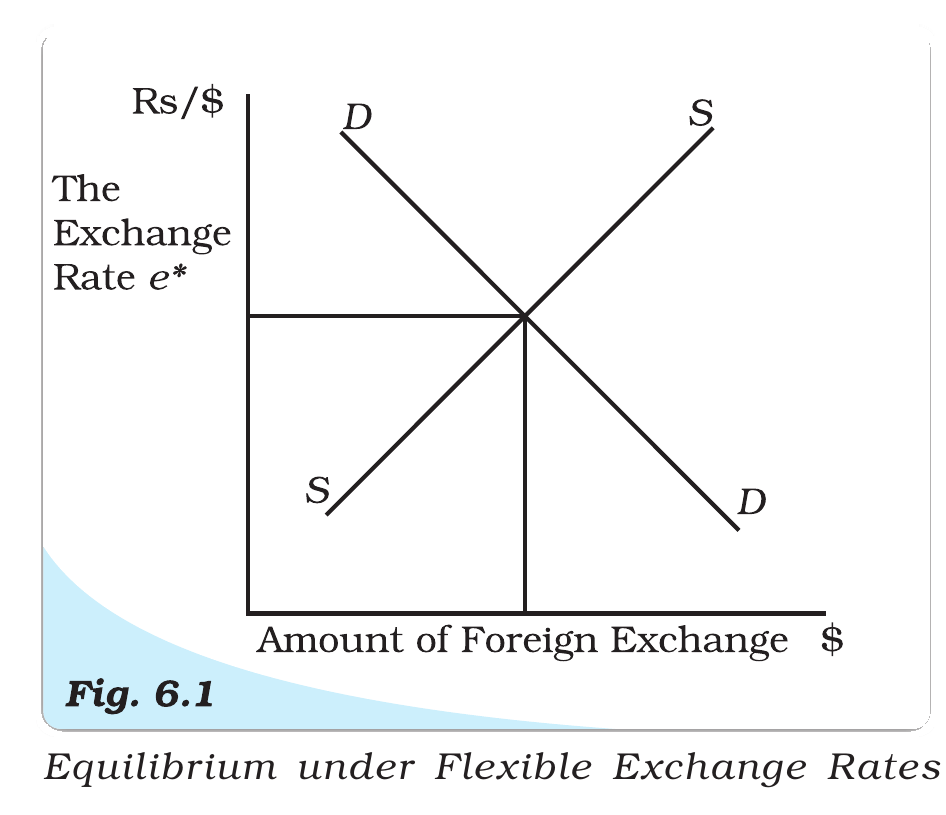
An exchange rate left to the market settles where the demand curve for foreign exchange meets the supply curve. This is the flexible exchange rate.
Option (1) Managed floating exchange rate — Incorrect. This mixes the flexible and fixed systems. The market moves the rate, but central banks step in to buy and sell foreign currencies.
Option (2) Flexible exchange rate — Correct. The rate is set by demand and supply alone. It rises and falls as they change.
Option (3) Fixed exchange rate — Incorrect. The government fixes the rate at a particular level. The central bank then buys or sells foreign currency to hold it there.
Option (4) Pegged exchange rate system — Incorrect. This is another name for a fixed rate. The rate is tied to a level by official action.
NCERT (2026-27): “Flexible Exchange Rate This exchange rate is determined by the market forces of demand and supply. It is also known as Floating Exchange Rate. As depicted in Fig. 6.1, the exchange rate is determined where the demand curve intersects with the supply curve, i.e., at point e on the Y – axis. Point q on the x – axis determines the quantity of US Dollars that have been demanded and supplied on e exchange rate. In a completely flexible system, the Central banks do not intervene in the foreign exchange market.… Fixed Exchange Rates In this exchange rate system, the Government fixes the exchange rate at a particular level.… Thus, through intervention, the Government can maintain any exchange rate in the economy.… 6.2.4 Managed Floating Without any formal international agreement, the world has moved on to what can be best described as a managed floating exchange rate system. It is a mixture of a flexible exchange rate system (the float part) and a fixed rate system (the managed part). Under this system, also called dirty floating, central banks intervene to buy and sell foreign currencies in an attempt to moderate exchange rate movements whenever they feel that such actions are appropriate.…”
|