
The figure shows two long parallel wires a and b with currents \(I_a\) and \(I_b\) in the same direction.
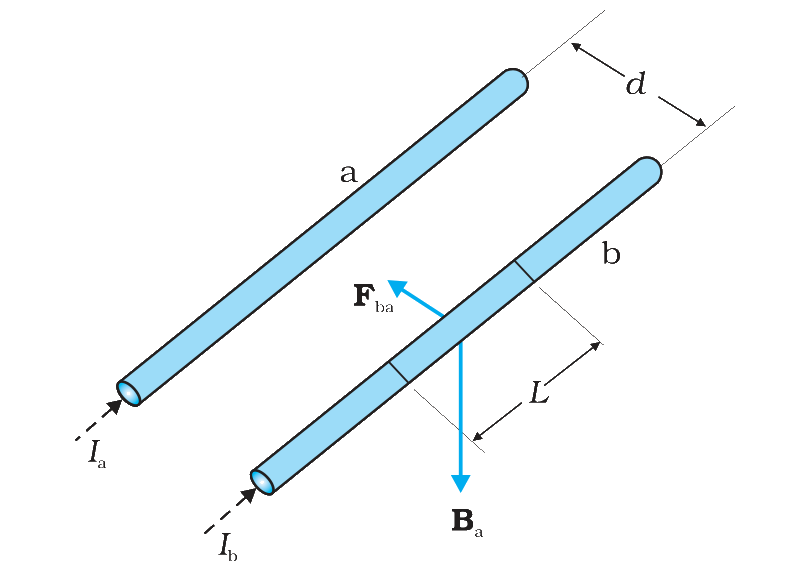
The current \(I_b\) is now reversed, while \(I_a\) is kept the same. Which of the following is correct?
Answer & explanation
Correct answer: option 1
The correct answer is Option (1) → \(\mathbf{B}_{a}\) stays the same, but \(\mathbf{F}_{ba}\) reverses and points away from a
\( \mathbf{B}_{a} \) is the field set up at b by the current \( I_a \) in conductor a. \( \mathbf{F}_{ba} \) is the force on b, and it depends on the current \( I_b \) as well as on \( \mathbf{B}_{a} \).
Option (1) \(\mathbf{B}_{a}\) stays the same, but \(\mathbf{F}_{ba}\) reverses and points away from a — Correct. The field of a does not depend on \( I_b \). The force \( I_b\mathbf{L}\times\mathbf{B}_{a} \) reverses with \( I_b \), so b is now pushed away from a. Antiparallel currents repel.
Option (2) \(\mathbf{B}_{a}\) reverses, but \(\mathbf{F}_{ba}\) stays the same — Incorrect. Conductor a makes \( \mathbf{B}_{a} \), and its current is unchanged. The force on b must change when \( I_b \) is reversed.
Option (3) Both \(\mathbf{B}_{a}\) and \(\mathbf{F}_{ba}\) reverse — Incorrect. Only the force depends on \( I_b \). The field \( \mathbf{B}_{a} \) keeps its direction because \( I_a \) is not changed.
Option (4) Both \(\mathbf{B}_{a}\) and \(\mathbf{F}_{ba}\) stay the same — Incorrect. With the same field and a reversed current, the force on b cannot keep its direction.
NCERT (2026-27):
Force Between Two Parallel Currents, the Ampere – “… The conductor ‘a’ produces, the same magnetic field Ba at all points along the conductor ‘b’. … Its magnitude is given by … Ampere’s circuital law,”
\( \displaystyle B_a=\frac{\mu_0 I_a}{2\pi d} \)
Force Between Two Parallel Currents, the Ampere – “Parallel currents attract, and antiparallel currents repel.”
FIGURE 4.17 Two long straight parallel conductors carrying steady currents Ia and Ib and separated by a distance d. Ba is the magnetic field set up by conductor ‘a’ at conductor ‘b’.