
CUETMOCK
  • Pricing
  • Mentors
Log inStart freeStart free mocks→

First test, then trust

Try a free CUET mock test.

Join 5,00,000+ students who rehearsed exam day on the exact NTA screen before sitting CUET. On the web and on Android.

Start free mocks →Get the Android app
CUETMOCK

India's #1 CUET Mock Test Platform. Original NCERT-based questions on the exact NTA exam screen — trusted by 5,00,000+ students since CUET 2022.

Get it onGoogle PlayScan to download the CUETMOCK app

Mock tests

  • CUET mock test series
  • Commerce mocks
  • Humanities (Arts) mocks
  • Science mocks
  • Languages & GAT mocks
  • Free practice questions
  • Pricing

Resources

  • CUET exam guide
  • CUET syllabus
  • Universities accepting CUET
  • Expert blogs
  • News & notifications
  • Webinars & counselling
  • CUET score calculator
  • How we estimate your rank
  • FAQs

Company

  • About us
  • Our leadership & team
  • Our toppers
  • Mentors
  • For schools
  • Contact us
  • Terms
  • Privacy
  • Refund policy

Talk to us

+91 7696 6630 56info@cuetmock.comWhatsApp us

Our other platforms

  • JEE Mock — For IIT-JEE aspirants
  • NEET Mock — For NEET aspirants

Newsletter

Exam updates, study material and offers — no spam.

© 2026 NYC Ventures Pvt. Ltd.

701-702, Royal Business Park, Zirakpur, Punjab - 140603

  • Terms of use
  • Privacy policy
  • Refund policy
  • Contact us

iCUETMOCK is an independent preparation platform, not affiliated with the National Testing Agency (NTA). Always check exam details on the official NTA website.

  • Home
  • Mock tests
  • CUET guide
  • Pricing
  • Log in
Home/Practice questions/Physics
PhysicsMagnetism and Matter

The figure shows the field lines of (a) a bar magnet, (b) a current-c…

The figure shows the field lines of (a) a bar magnet, (b) a current-carrying finite solenoid and (c) an electric dipole. The curves marked i and ii are closed surfaces.
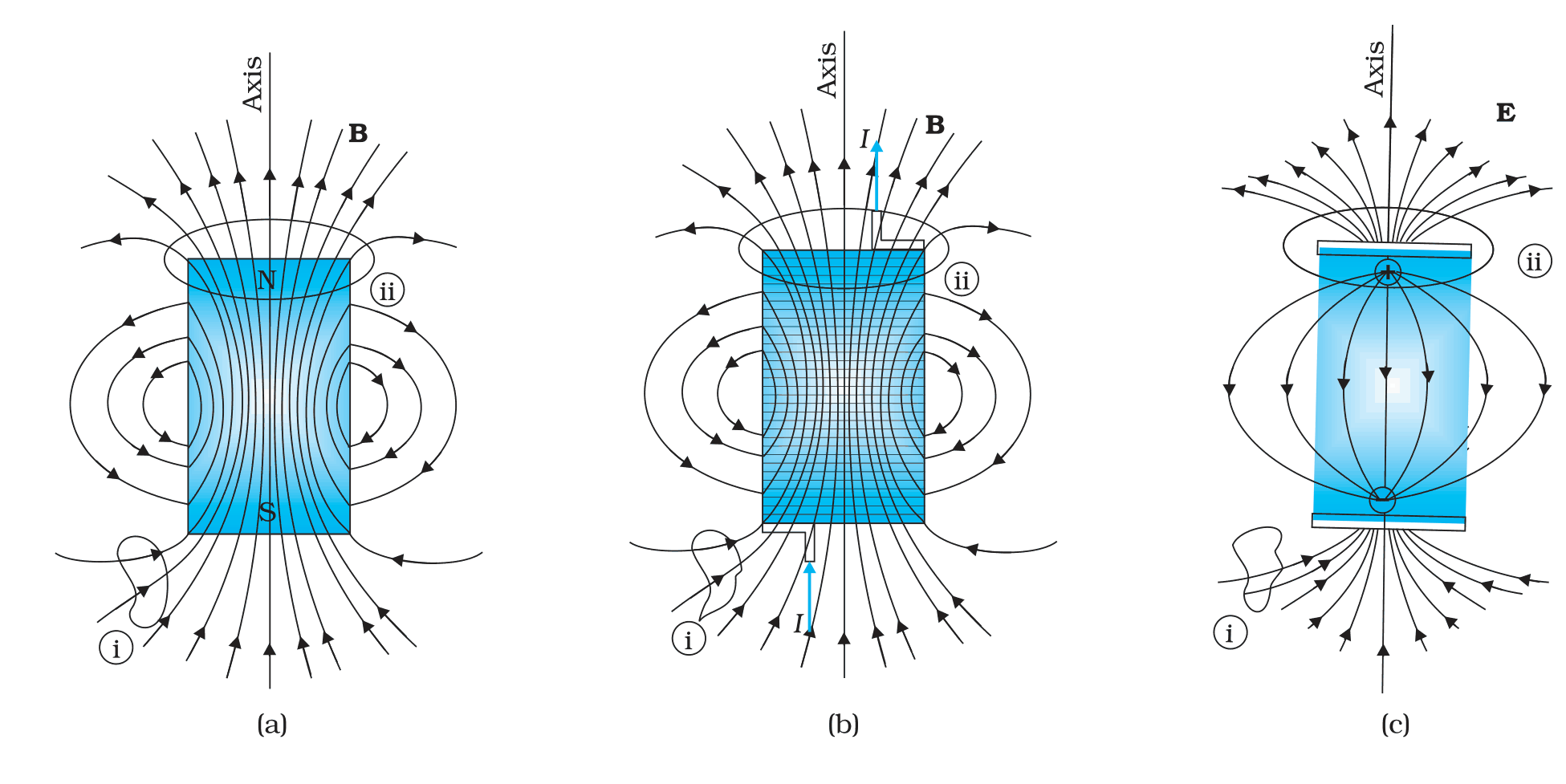
Field lines of a bar magnet, a finite solenoid and an electric dipole

Which of the following is correct about the net flux of the field through the closed surface ii?

Answer & explanation+

Correct answer: option 4

The correct answer is Option (4) → It is zero in (a) and (b), and outward in (c).

Magnetic field lines are continuous and form closed loops. So as many magnetic lines leave a closed surface as enter it, and the net magnetic flux is zero. Electric field lines start on a positive charge and end on a negative charge. So a closed surface that holds a net charge has a net flux through it.

Option (1) It is zero in all three cases. — Incorrect. In (c), the surface ii holds the positive charge of the dipole. More lines leave this surface than enter it.

Option (2) It is outward in (a) and (b), and zero in (c). — Incorrect. In (a) and (b), the lines that leave surface ii outside the magnet are the same lines that enter it from inside. Their flux balances to zero. In (c) the surface holds a net charge, so the flux is not zero.

Option (3) It is outward in (a), and zero in (b) and (c). — Incorrect. A bar magnet and a solenoid have the same kind of closed field lines. So the flux through ii is zero in (a), just as in (b). In (c) it is not zero.

Option (4) It is zero in (a) and (b), and outward in (c). — Correct. The magnetic lines through ii balance in (a) and (b). In (c) the surface ii holds a net positive charge, so there is a net outward flux.

NCERT (2026-27):
Magnetism and Gauss’s Law – “… In Fig 5.2(c), we see that for a closed surface represented by i , the number of lines leaving the surface is equal to the number of lines entering it. … However, in the same figure, for the closed surface ii , there is a net outward flux, since it does include a net (positive) charge.”


Magnetism and Gauss’s Law – “The situation is radically different for magnetic fields which are continuous and form closed loops. Examine the Gaussian surfaces represented by i or ii in Fig 5.2(a) or Fig. 5.2(b). Both cases visually demonstrate that the number of magnetic field lines leaving the surface is balanced by the number of lines entering it. The net magnetic flux is zero for both the surfaces.”

Fig. 5.2 The field lines of a bar magnet, a current-carrying finite solenoid and electric dipole

FIGURE 5.2 The field lines of (a) a bar magnet, (b) a current-carrying finite solenoid and (c) electric dipole. At large distances, the field lines are very similar. The curves labelled i and ii are closed Gaussian surfaces.

Advertisement

Practise more on Magnetism and Matter

Chapter-wise mocks on the real NTA exam screen, with solutions and your rank. Your first mocks are free.

Start free mocks →

Advertisement

Next questions

  1. A solenoid of length 0.5 m and radius 10 cm has 500 turns. If a current of 5 A flows through it, the magnetic field produced inside the sol…Physics · Moving Charges and Magnetism
  2. A function f is defined by f(x)=2+(x-1)^2 / 3 on [0,2]. Which of the following is not correct?Maths. Section B1 · Continuity and Differentiability
  3. Out of the following which initiative by the Government of India aims at creating a balance, structure and quality in India's ecology?Sociology · Social Change and Development in India: Social Movements
  4. Match List I with List IILIST ILIST IIA. Tendrils of Cucurbita and thorns of BougainvilleaI. Convergent evolutionB. Sweet potato and potato…Biology · Evolution
  5. A point P(R√3, 0, 0) lies on the axis of a ring of mass M and radius R. The ring is located in y - z plane with its centre at origin O. A s…Physics · Gravitation
  6. The juvenile rhesus ____ the author by reflecting an overtly ____ approach.English · Comprehension - (Narrative / Factual)
  7. If A and B are two events such that P(A) = 1/2, P(B) = 1/3 and P(A mid B) = 1/4, then P(A' ∩ B') is equal toMaths. Section B1 · Probability
  8. In a coil, the current is changed from 12 A to 24 A in 1 s. The self-induced emf of the coil is 24 V. The change in energy in the coil isPhysics · Electromagnetic Induction
  9. दो स्वरों के पास आने से जो संधि होती है वह कहलाती है-Hindi · व्याकरण - सन्धि
  10. The study of relationship between natural and human worlds is called ________.Geography · Fundamentals of Human Geography: Human Geography-Nature and Scope