The area of the region $\{(x,y): x^2 + y^2 ≤ 1 ≤ x + y\}$ is
Answer & explanation
Correct answer: option 3
The correct answer is Option (3) → $\frac{1}{2}\left(\frac{\pi}{2}-1\right)$ sq.unit
The region is defined by:
- Inside the unit circle: \( x^2 + y^2 \leq 1 \)
- Above the line: \( x + y \geq 1 \)
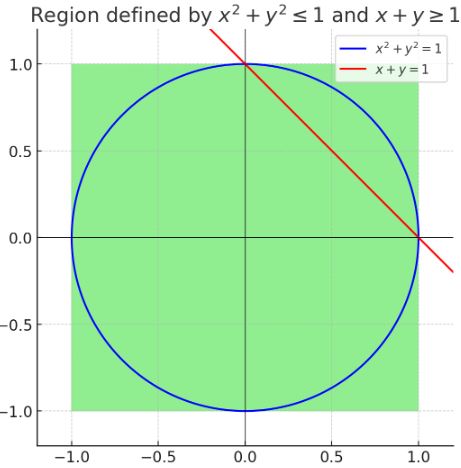
The area bounded by both is the region of the unit circle where \( x + y \geq 1 \).
The line \( x + y = 1 \) intersects the circle \( x^2 + y^2 = 1 \) at,
Points of intersection:
Substitute \( y = 1 - x \) into the circle:
\( x^2 + (1 - x)^2 = 1 \Rightarrow x^2 + 1 - 2x + x^2 = 1 \Rightarrow 2x^2 - 2x = 0 \Rightarrow x(x - 1) = 0 \)
So intersection points are \( (0,1) \) and \( (1,0) \).
The area under the arc from (0,1) to (1,0) lies above the line \( x + y = 1 \), which forms a sector of 90° (or \( \frac{\pi}{2} \) radians) and a triangle with vertices (0,1), (1,0), and (0,0).
Area of quarter circle: \( \frac{1}{4} \pi r^2 = \frac{\pi}{4} \)
Area of triangle: \( \frac{1}{2} \times 1 \times 1 = \frac{1}{2} \)
Required area = Area of sector − Area of triangle = \( \frac{\pi}{4} - \frac{1}{2} \)